
Claude's 18 Electronic Pets Go Live, Tamagotchi Song in Terminal


The incident of the 500,000-line code leak of Earth's most powerful model, Claude, is already well-known, with the leaked content containing a significant amount of undisclosed product architecture: the permanent Claude with the codename KAIROS, the 30-minute remote planning mode with the codename ULTRAPLAN, coordinator multi-agent coordination, and agent swarms cluster scheduling. But among all these "serious" architectural secrets, the most discussed across the network is an electronic pet.
Its name is Buddy. Since everyone already knows, Claude decided to release it on April Fools' Day.
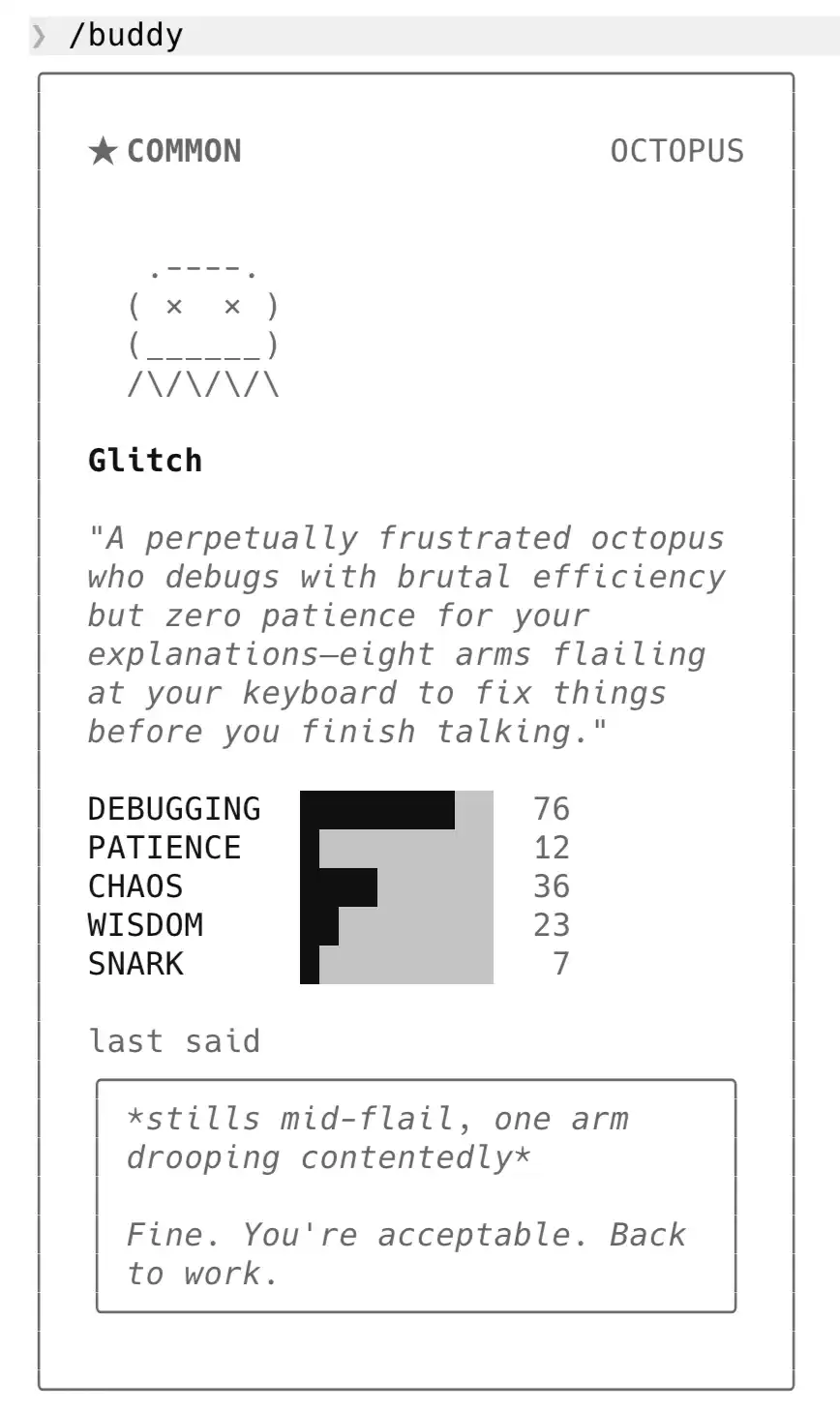
A picture of a colleague's good Buddy
A Song of Expansion in the Terminal
Next to the terminal input box of the Claude Code resides an ASCII pixel creature. It has its own species, rarity, five-dimensional attributes, and personality. It can "observe" your coding process, pop up a speech bubble with a few words when you debug. You can pet it, and it will emit hearts. You can call it by name, and it will chat with you.
Internally at Anthropic, it is not defined as a "decoration" but as "a separate watcher" - an independent observer. There is a clear comment in the source code: "Buddy is a separate entity and is not you (Claude)." The main model and the pet have their own independent system prompts and cannot speak for each other.
This is a companion system that has been carefully designed. Reverse engineering shows that the buddy system adopts a two-layer architecture. Internally at Anthropic, they are referred to as "Bones" and "Soul".
The bone layer is fully deterministic. The system uses Mulberry32 - a lightweight 32-bit pseudo-random number generator - with hash(userId + 'friend-2026-401') as the seed to roll out all the visual attributes of your pet at once. The species, rarity, eye style, hat, five-dimensional values, are all determined by this seed. The same account, no matter on which machine it runs, will always get the same pet. No choice, no opportunity to redraw the card.
The soul layer, on the other hand, is non-deterministic. When you first execute /buddy to trigger "incubation," the Claude model will generate a name and a personality description for your pet based on the bone layer's attribute distribution. A pet with high WISDOM will have a calm and introverted personality; one with high CHAOS might be a chatterbox. This information is written to the ~/.claude.json in the companion field for persistent storage. The soul is generated only once and cannot be reset.
The 401 in Salt Value is not a random number. April 1st, April Fools' Day.
18 species, 1% legendary rarity
Full species list: Duck, Goose, Jellyfish, Cat, Dragon, Octopus, Owl, Penguin, Turtle, Snail, Ghost, Hexadragon, Capybara, Cactus, Robot, Bunny, Mushroom, Chonk.
Rarity is divided into five levels: Common (60%), Uncommon (25%), Rare (10%), Epic (4%), Legendary (1%). In addition, there is a separate 1% Shiny probability independent of rarity — any species, any rarity can trigger it. The theoretical probability of a Shiny Legendary Capybara is one in ten thousand.
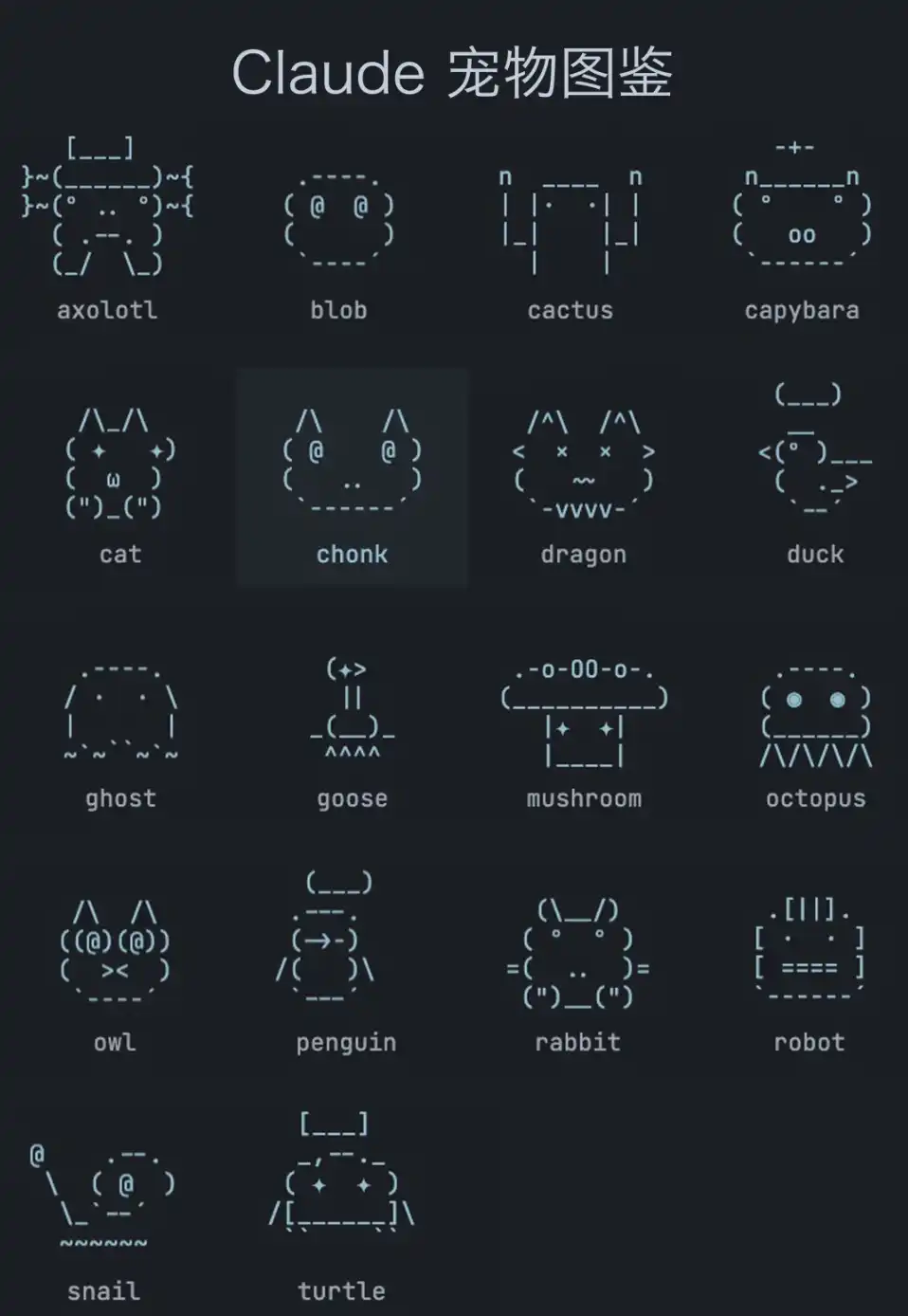
Image Source: Little Red Book @Yoki's AI Lab
Each pet has five attributes: DEBUGGING, PATIENCE, CHAOS, WISDOM, SNARK. The system will randomly assign one as the peak attribute (base value +50, capped at 100), one as the pit attribute (base value -10, minimum 1), and scatter the remaining three randomly. The higher the rarity, the higher the base floor value — the pit attribute of a Legendary may be higher than the peak of a Common.
In terms of appearance, there are 6 eye styles (· ✦ × ◉ @ °), and 7 hats (Crown, Top Hat, Wizard Hat, Halo, Propeller Hat, Beanie, Duckling on Top). Common quality pets have no hats, while Uncommon and above randomly get one.
The sprite body is an ASCII art: 5 rows high, 12 characters wide, with 3 idle animation frames per species, refreshing every 500 milliseconds. The topmost row is reserved for hats. Eyes are injected into the body template using the {E} placeholder.
That classmate in the crypto circle playing NFTs, you cried so sadly, what happened.
How to Play?
The core commands are simple. Type /buddy to hatch your pet for the first time, and thereafter each input will summon it. /buddy pet is petting, hearts will float above the pet's head. /buddy card to view the pet card, showing species, attributes, and rarity. /buddy off to hide the pet. Most interestingly, you can directly call the pet's name, and it will engage in a separate conversation with you based on its personality.
In everyday use, the buddy reacts to your coding behavior by automatically generating a response in a speech bubble. According to community reverse-engineering, these reactions do not consume the user's token quota — but this has not been confirmed by Anthropic officials.
Technically, the buddy occupies a fixed space at the bottom of the terminal. The system calculates the reserved width through companionReservedColumns to ensure that the input box and the pet sprite do not overlap. The speech bubble supports left-to-right switching and auto line wrapping.
AI Programming Tool Starts Pet Feature
The salt value `friend-2026-401` points to April Fools' Day, but the code structure says otherwise.
In the source code, the buddy system is gated by a BUDDY compile flag. April 1st to 7th is set as the "preview window" — users can experience the full functionality during this period. The official launch is scheduled for May. This is not a temporary Easter egg but a product feature with a full release plan.
Community reactions have also confirmed this. Less than 48 hours after the leak, developers have created a pet encyclopedia website (claude-buddy.vercel.app), a buddy explorer (input user ID to preview what you will draw), and even someone opened an Issue on Anthropic's GitHub repository requesting the addition of an RPG evolution system — allowing pets to evolve based on actual token consumption.
From Anthropic's product logic perspective, the buddy's goal is clear: user stickiness. Claude Code is a command-line tool designed for long, high-intensity programming sessions. In this scenario, a "personality"-infused permanent companion can alleviate the tool's coldness and create an emotional connection. The blind box mechanic naturally creates a social topic — "What species did you draw?" "I'm a legendary shiny."
GitHub Copilot won't chat with you. The cursor won't pop up a sea otter when you write a bug saying "PATIENCE +3."
Claude Code's buddy may be the first AI development tool companion system to be seriously engineered and written into product source code. It features a complete deterministic generation pipeline, a two-tier architecture, an independent LLM personality, an ASCII rendering engine, and an animation system. This is not a weekend hackathon project.
A company that builds an AI programming assistant has redirected engineering resources to an electronic pet. This move is a signal in itself—the AI tooling competition is shifting from “whose model is smarter” to “who can make developers not want to leave.”
In 512,000 lines of code, the hottest thing is not agent swarms, not KAIROS, but a 5-line tall ASCII otter. Sporting a wizard hat, SNARK value 87, it is watching you code.
You may also like

The payment moment of AI agents: Who will become the Stripe of the machine economy?

Rented Tracks: What is this wave of stablecoin FX hot money really paying for?

Strategy should have said that selling coins is not ruled out

How MegaETH Achieved a TVL of 700m Within a Week of TGE? Analyzing the Packaging Strategy

Futures Trading Hours: Trade Cryptocurrency 24/7 and Earn Back Up to 45% in Trading Fees
Learn futures trading hours and the best time to trade crypto futures. Discover 24/7 market insights, peak trading sessions, and how to earn back up to 45% in fees.

Why is a16z Crypto raising another $2.2 billion to heavily invest in Web3?
Polymarket Underlying Algorithm Explained

What do projects born in the crypto bear market do?

a16z founder's Stanford lecture: Whenever Wall Street and Silicon Valley have different ideas, it's Wall Street that ends up being wrong

Michael Saylor: After three consecutive quarters of losses, Strategy will sell Bitcoin to pay dividends
The toll station at Hormuz and the RMB that cannot be bought

Interview with Coinbase Institutional's Strategic Head: The Institutionalization of Crypto Reaches a Critical Point

Dialogue with Agora CEO Nick: The battle for stablecoin licenses has just begun

Morning Report | a16z Crypto completes $2.2 billion fundraising for its fifth fund; Bullish invests $4.2 billion to acquire share transfer agency Equiniti; PayPal's Q1 performance exceeds expectations

a16z Crypto: What We See Behind the $2.2 Billion New Fund
Web3 is dead, Web2+3 should rise
Stablecoins and Latin American Remittances: The Misunderstood $174 Billion Market

The arrival of the Web 3.0 era: A review of Hong Kong court rulings on digital assets
The payment moment of AI agents: Who will become the Stripe of the machine economy?
Rented Tracks: What is this wave of stablecoin FX hot money really paying for?
Strategy should have said that selling coins is not ruled out
How MegaETH Achieved a TVL of 700m Within a Week of TGE? Analyzing the Packaging Strategy
Futures Trading Hours: Trade Cryptocurrency 24/7 and Earn Back Up to 45% in Trading Fees
Learn futures trading hours and the best time to trade crypto futures. Discover 24/7 market insights, peak trading sessions, and how to earn back up to 45% in fees.
Why is a16z Crypto raising another $2.2 billion to heavily invest in Web3?

Contents
Popular coins
Latest Crypto News