

Best Crypto Futures Trading Platforms in October 2025

Key takeaways
- Choosing the right crypto futures exchange depends heavily on evaluating key aspects such as fee structures, platform usability, range of supported assets, and—most importantly—security measures.
- Trust and security are frequently the top priorities, especially since many exchanges also serve as custodians for users’ digital assets. Key features to look for include Proof-of-Reserves (PoR), two-factor authentication (2FA), and a proven operational track record.
- Regional accessibility is another essential factor. With crypto regulations evolving worldwide, many derivatives platforms limit services to specific countries, and some may only offer a narrow set of markets or trading pairs depending on the user’s location.
What is Crypto Futures Trading?
Crypto futures are derivative contracts that derive their value from an underlying digital asset, such as Bitcoin or Ethereum. Unlike spot trading, futures do not involve immediate transfer of the actual cryptocurrency. Instead, traders agree to buy or sell an asset at a predetermined price on a future date.
While the basic mechanics of futures trading may resemble spot trading, futures open the door to more sophisticated strategies—including leveraged positions and the ability to go long or short. This allows traders to speculate on price movements without owning the underlying asset. In today’s crypto markets, derivatives trading volume consistently surpasses that of spot markets.
Which Crypto Exchange Offers the Best Futures Trading?
Over the past ten years, the cryptocurrency exchange landscape has evolved from rudimentary trading websites into a sophisticated financial ecosystem. Leading platforms now offer advanced trading products coupled with robust security frameworks, serving not only as venues for spot and derivatives trading but also as gateways bridging digital assets with traditional finance.
Selecting a suitable futures trading platform requires careful evaluation, as each exchange offers distinct advantages in areas such as fee models, leverage options, and risk management tools. These differences can significantly influence trading outcomes, risk exposure, and overall user experience. The optimal choice varies by individual, reflecting diverse trading strategies, asset preferences, and risk tolerance levels.
In the assessment that follows, we examine key futures trading platforms based on critical factors including security protocols, product diversity, fee competitiveness, and interface design. This analysis aims to equip traders with the insights needed to identify the exchange that best aligns with their specific trading objectives and operational requirements.
1. WEEX
WEEX stands as an emerging force in the crypto derivatives landscape, establishing its presence through competitive trading conditions and user-centric features. The platform has built a reputation for providing reliable execution capabilities combined with an accessible trading environment suitable for both novice and experienced traders.
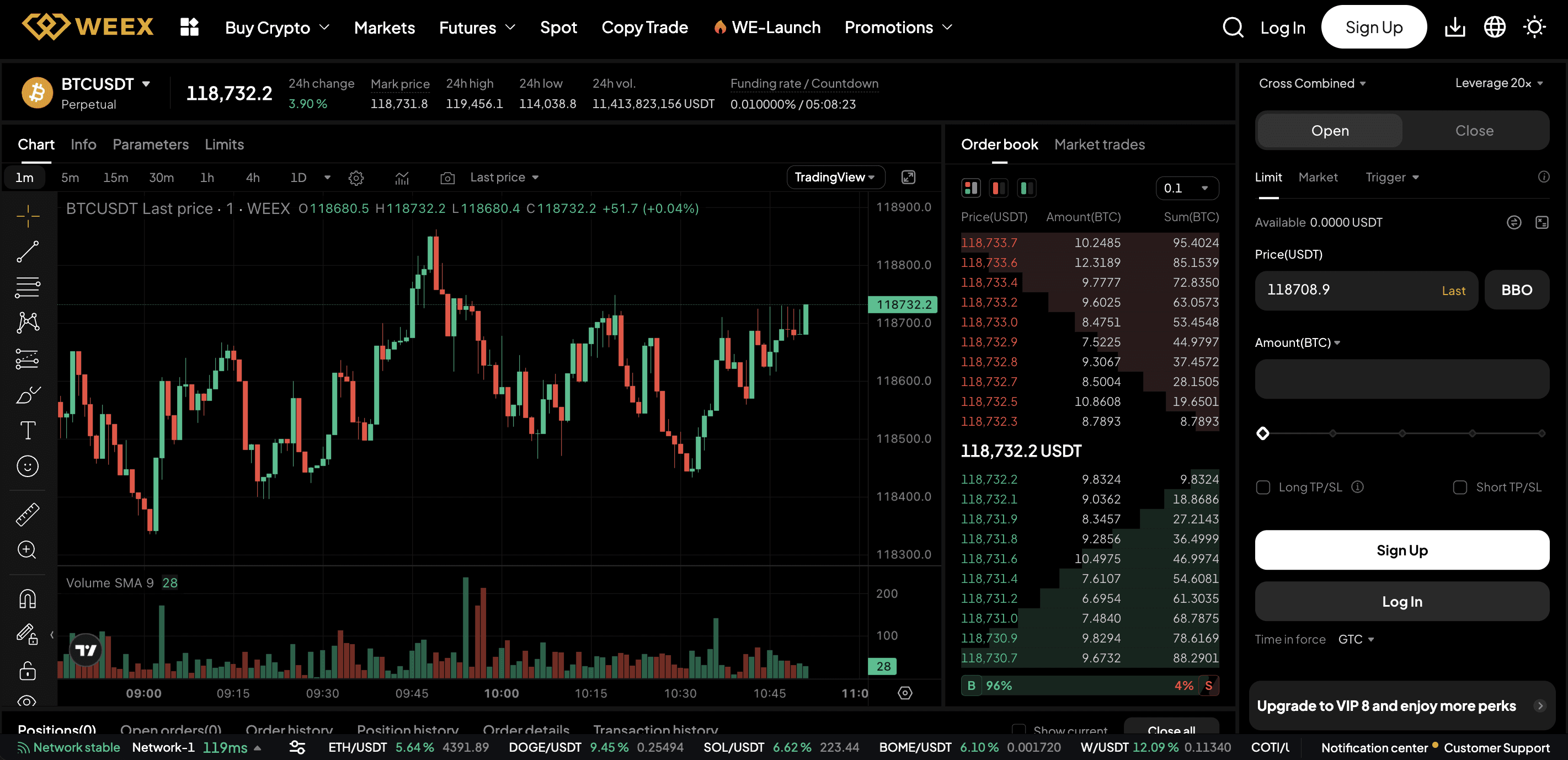
The exchange offers substantial leverage options reaching up to 400x across a diverse portfolio of 1700+ trading pairs. Its fee structure remains competitive at 0.02% for maker orders and 0.08% for taker orders. Among its standout features is an industry-leading commission rebate program that offers up to 90% rebates, distributing over $12 million in monthly commission payouts to its user base. The platform's interface design emphasizes simplicity and functionality, delivering an ad-free trading experience that eliminates distractions while maintaining comprehensive tool access.
WEEX demonstrates impressive liquidity metrics, currently ranking second industry-wide in critical depth measurements including order book density and narrow price spreads. The platform's BTC markets can comfortably accommodate transactions of at least 800 BTC within a minimal 0.01% price variance, showcasing robust market depth.
Also, WEEX Liquidity has earned recognition from authoritative platforms like Cryptorank, a testament to our robust market depth. This is exemplified by the ability to trade 800 BTC within a razor-thin 0.01% spread, a feature that directly contributes to lightning-fast, zero-lag trade execution and minimizes slippage for our users.
To master future trading, just read How to Trade Bitcoin Futures on WEEX and do your first future trading now!
Pros
- Easy-to-use interface
- Strong futures and copy trading features
- No KYC for basic use
- Competitive fees
- Transparent reserves and protection fund
Con
- No fiat withdrawals
2. MEXC
MEXC remains one of the largest crypto futures brokers for daily trading volume. It handles several billion dollars each day, providing futures trades with deep liquidity and tight spreads.
The platform offers perpetual futures, which rely on traditional order types but without expiration dates. Over 900 futures markets are listed, including the best meme coins like Pepe, Bonk, and Shiba Inu. MEXC supports linear and inverse contracts, and they settle in USDT or the underlying asset, respectively.
Leverage is available on all crypto futures, with large-cap pairs providing 500x multiples. The exchange reduces leverage limits on markets with weaker liquidity to help traders mitigate risk. The futures dashboard allows full customization, and users deploy drawing tools and technical indicators for real-time analysis.
Research shows that MEXC is one of the best crypto futures trading platforms for low fees. Traders pay just 0.01% per side on limits and 0.04% on markets.
New users register with an email address only and remain anonymous unless they withdraw more than 20,000 USDT daily, or 100,000 USDT monthly.
Pros
- Access over 900 perpetual futures markets
- Choose between linear and inverse contracts
- Pay a maximum futures trading commission of 0.04%
- No KYC when withdrawing under 20,000 USDT daily
Cons
- The platform operates offshore without regulation
- U.S. traders cannot access the exchange
3. Binance
Binance is a good option for traders who prefer traditional delivery futures over perpetuals. The tier-one exchange provides quarterly and bi-quarterly contracts for Bitcoin and Ethereum. These futures contracts, unlike perpetuals, do not incur funding fees. Traders may exit positions early, but they can also hold until the contract expiration date. This structure allows Binance users to trade futures with longer-term strategies.
Binance also caters to perpetual traders, with over 530 available markets. You can access the best altcoins, including Sui, Dogecoin, BNB, and Cardano, with leverage up to 125x.
The platform is known for its advanced trading tools, as Binance traders access multiple timeframes, indicators, deep order books, and automated bots. Accessibility includes desktop and mobile trading, ensuring futures traders monitor positions on the move.
Regarding fees, market makers get the lowest trading commissions of 0.018% per side. Takers pay more than double at 0.045%.
Pros
- Trade delivery futures with quarterly and bi-quarterly expirations
- Suitable for entering longer-term futures trades without funding fees
- Also supports over 530 perpetual markets
- The exchange boasts over 283 million users
Cons
- Delivery futures support Bitcoin and Ethereum only
- Restricts leveraged products in the U.S.
- Often relies on third-party gateways for fiat payments
4. OKX
OKX offers one of the most extensive derivative ecosystems, including a comprehensive range of cryptocurrencies, instruments, and contract types.
Day traders may prefer OKX's perpetual futures market, which covers over 290 digital assets. Users find their favorite coin or token through narrative filters like RWA, AI, meme coins, and Layer 1. Perpetual futures incur funding rates every eight hours, and only longs or shorts are charged.
The next option is delivery futures, with only daily and weekly markets available for Bitcoin and Ethereum. These contracts offer longer-term exposure without funding fees. OKX also supports crypto options for the two market leaders. Seasoned traders access fully-fledged options chains with multiple strike prices and expiration dates, while beginners use the Simple Options tool for an easier trading experience.
OKX's entry-level commission when trading futures via market orders is 0.05% per side. Market makers and those who meet 30-day volume milestones receive lower commissions.
Pros
- Access perpetuals, delivery futures, and options in one safe place
- High-level charting tools with 100+ technical indicators
- Heavily regulated in several global markets
Cons
- U.S. traders can access OKX spot trading but not futures products
- Delivery contracts support daily and weekly expirations only
- Strict onboarding process with enhanced KYC
5. Bybit
If you're looking for the best crypto futures trading platform for supported markets, Bybit is a top choice. With over 600 perpetual contracts, Bybit provides access to a wide range of digital assets. Alongside market leaders like Bitcoin, XRP, BNB, and Ethereum, users trade volatile meme coins such as Popcat, SPX6900, Brett, and Peanut the Squirrel. Traders also speculate on decentralized finance (DeFi) futures contracts, from Zora and Uniswap to Pendle, Aave, and Ondo.
Most futures markets trade with USDT, although select pairs also support USDC. Platform users also choose between linear and inverse contracts, depending on their risk tolerance and trading goals. Bybit offers leverage of up to 200x on major pairs, but these limits decline when trading more volatile markets.
The exchange's fee structure is competitive and transparent. Traders pay 0.02% or 0.055% per side when placing limit or market orders, respectively. The platform also charges a small 0.05% settlement fee.
Pros
- Gain exposure to over 600 digital assets via leveraged futures contracts
- Supports smaller-cap meme coins with high volatility
- Contract specifications include linear and inverse settlement
Cons
- The charting platform may be overwhelming for beginners
- Bybit is not available in the U.S. or the UK
- Its derivative markets are not approved by any regulators
Why Choose WEEX?
Founded in 2018, WEEX has rapidly grown into one of the most trusted crypto exchanges, serving over 6.2 million users across 130+ countries. With a strong emphasis on security, liquidity, and ease of use, WEEX provides over 1,700 trading pairs and up to 400× leverage for futures trading, making it a powerful option for both beginners and pro traders.
Which Crypto Futures Exchange is Right for Me?
With hundreds of crypto futures exchanges to choose from, identifying your best option can be difficult. Ultimately, your trading proficiency, country of residence, and risk tolerance will all play a major part in informing your decision, which will naturally differ from another trader’s.
Trading proficiency: Different venues cater to different trader niches — though most are accessible to all skill levels, some offer unique products or features that are purpose-built for beginners or pro traders. Related is the user experience the exchange provides. The ease with which you can navigate the platform is critical in capitalizing on trades. Traders just getting familiar with how to integrate futures trading into their crypto strategy will likely have a different workflow than a seasoned high-frequency trader capturing arbitrage opportunities. Choosing the best crypto futures exchange for you may depend on your overall proficiency and familiarity with crypto trading to begin with, before you find the platforms that have the right features that match your needs.
Country of residence: With ever-changing global regulations, platforms can rarely offer true global coverage without running afoul of legislation. The same exchange may often need to provide a completely different experience from one country to the next to remain compliant. It’s worth considering exchanges that are proactive and transparent on this front — namely, those that actively strive to obtain the required licenses and comply with regulations.
Risk tolerance: Trusting a third-party with your funds comes with an inherent risk that they could be lost. It’s impossible to engage with a custodial exchange fully trustlessly, though you should familiarize yourself with prospective platforms’ security commitments and the measures they take to reduce your risk. Look for exchanges that implement measures such as Proof-of-Reserves (POR) audits, SOC compliance, and 2FA. Consider their track record and any major security breaches they may have sustained historically.
Trade Now
Time after time, both new and seasoned futures traders turn to WEEX for its seamless trading experience, top-tier security, and diverse product lineup.
Join millions of users who trust WEEX to trade futures and stay ahead in the fast-evolving crypto market. Start now!
You may also like

What Is Shiba Inu (SHIB) Crypto? Origin, Creator, and How to Buy in 2026: Complete Guide for Beginners
Shiba Inu (SHIB) started as a joke. A quadrillion tokens sent to a stranger who burned most of them. That stranger was Vitalik Buterin. The creator? Nobody knows—just a name: Ryoshi. Five years later, SHIB has a DEX, NFTs, a game, and a massive community. But is it still a meme coin or something more? Here's what you need to know before buying.
Who Created Shiba Inu?Shiba Inu launched in August 2020. The creator goes by Ryoshi—a fake name. No one knows who Ryoshi really is. That's common in meme coins.
Ryoshi wanted to make a "Dogecoin killer." A token built by the people, for the people. No venture capital. No presale. Just a fair launch.
The project took the Shiba Inu dog breed as its mascot. Same dog as Dogecoin. That wasn't an accident. SHIB was meant to compete with DOGE from day one.
The Origin of Shiba Inu: How Shiba Inu StartedThe origin story is weird but important. Ryoshi launched SHIB with a total supply of 1 quadrillion tokens. Yes, quadrillion.
Here's what happened next:
50% locked in Uniswap. That created initial liquidity. The keys were sent to Vitalik Buterin (Ethereum co-founder) for safekeeping.50% sent to Vitalik Buterin. That was the weird part. Ryoshi sent half the supply to one person.Then Vitalik did something no one expected. He burned 90% of what he received. That's about 410 trillion SHIB sent to a dead wallet—gone forever. The rest he donated to India's COVID-19 relief fund.
That burn made SHIB scarce overnight. The donation made headlines. The token went viral.
How Does Shiba Inu Work?Shiba Inu runs on Ethereum. Not its own blockchain. That means SHIB is an ERC-20 token. You need ETH for gas fees when you move or swap SHIB.
The original plan was simple: be a meme coin. But over time, the project added more pieces.
Current ecosystem includes:
SHIB token – The main coin. Used for trading and payments.LEASH token – A smaller supply token. Originally a rebase token, now more like a companion coin.BONE token – Governance token for the Doggy DAO. Used to vote on proposals.ShibaSwap – A DEX where you can swap, stake, and farm SHIB, LEASH, and BONE.So SHIB is no longer just a meme coin. It has a swap, NFTs, and a game. But most people still buy SHIB because of the hype.
Why Is Shiba Inu So Popular?Two reasons. The burn and the community.
The Vitalik burn made SHIB a story. A quadrillion supply cut by 40% overnight. That's rare. People paid attention.
Then the community took over. SHIB became the "people's token." No big investors. No insiders. Just regular people buying small amounts.
Elon Musk tweeted about Dogecoin in 2021. That lifted all dog coins. SHIB rode that wave. From January to November 2021, SHIB went up something like 60,000,000%. Not a typo.
That kind of return brings in more buyers. FOMO spreads. Price goes up more.
Shiba Inu Tokenomics: Supply and BurnsOriginal supply: 1 quadrillion.
After Vitalik's burn: roughly 549 trillion left.
Total supply now changes over time because of burns. ShibaSwap has burn mechanisms. NFT naming burns SHIB. The game burns SHIB.
But the burns are small compared to that first big one. Don't expect burns to make SHIB scarce quickly. It would take decades at current rates.
Key numbers:
Circulating supply: ~589 trillion SHIBMarket cap: Varies wildly. Was $40 billion at peak. Much lower now.Price: Fractions of a cent.How to Buy Shiba Inu (SHIB): Step-by-Step GuideIf you want to buy SHIB, here's the simplest way.
Step 1: Create & Verify AccountDownload WEEX App or visit WEEX official website → Sign up with email/phone → Complete KYC.
Step 2: Deposit FundsGo to "Assets" → "Deposit":
Fiat: Bank transfer, card, or third-party paymentCrypto: Send USDT or BTC to your WEEX walletStep 3: Buy Shiba Inu (SHIB)Spot Trading: "Trade" → "Spot" → SHIB/USDT → Market order (buy now) or Limit order (set price) → Confirm.Shiba Inu vs Dogecoin: What's the diffrenceFeatureShiba Inu (SHIB)Dogecoin (DOGE)BlockchainEthereumDogecoin (own chain)Supply~589 trillionUnlimited (10k per minute)CreatorRyoshi (anonymous)Billy Markus (public)EcosystemShibaSwap, NFTs, gameLimitedGas feesETH gas (can be high)Very lowSHIB has more built-in utility now. DOGE is simpler and has Elon Musk's support. Both are high-risk meme coins.
Is Shiba Inu (SHIB) a Good Investment?Whether Shiba Inu is a good investment depends on what you want. If you want to gamble a small amount on a well-known meme coin with an active community, SHIB fits. If you want long-term steady returns or actual cash flow, look elsewhere.
SHIB is not a company. It doesn't make profits. You're betting that more people will buy SHIB in the future than sell it. That's speculation, not investing. Only put in what you can lose. Seriously.
ConclusionShiba Inu started as a joke by an anonymous creator named Ryoshi. The origin story—1 quadrillion supply, half sent to Vitalik, massive burn—made it famous. The community kept it alive.
Now SHIB has a DEX, NFTs, and a game. It's more than a pure meme coin. But it's still a meme coin. Price moves on hype, not fundamentals.
If you understand the risks and want to speculate, go ahead.
Ready to trade? WEEX offers zero fees, instant execution, and the security you need. Sign up on WEEX Now and Start Trading!
FAQWho created Shiba Inu?An anonymous person or group using the name Ryoshi created Shiba Inu in August 2020. No one knows Ryoshi's real identity.
What is the origin of Shiba Inu crypto?Ryoshi launched SHIB as a "Dogecoin killer" with a supply of 1 quadrillion tokens. Half went to Uniswap for liquidity. Half went to Vitalik Buterin, who burned 90% and donated the rest.
How does Shiba Inu work?SHIB is an ERC-20 token on Ethereum. It can be traded, staked on ShibaSwap, and used in the Shiba Inu ecosystem including NFTs and a game.
Is Shiba Inu a good investment?SHIB is high-risk speculation. It has no revenue or fundamentals. Only invest what you can afford to lose.
What is the difference between SHIB, LEASH, and BONE?SHIB is the main token. LEASH is a smaller supply companion token. BONE is the governance token for the Doggy DAO.

How to DYOR in 2026: A Complete Guide for Beginners
A friend of mine lost $12,000 last year. Bought a token because some YouTuber said "this is the next 100x."
Two weeks later? Zero. Rug pulled.
That is why DYOR exists. Here is what it actually means and how to do it without losing your money.
What Does DYOR Mean?DYOR stands for Do Your Own Research. Simple, right? Most people skip it anyway.
Here is why. Researching is boring. Watching green candles is exciting. But the person on Twitter telling you to buy? They probably bought cheaper. They want you to pump their bags.
Do not be that exit liquidity.
Why DYOR Matters in 2026Anyone can create a token. Takes 10 minutes and $50.
That means bad actors launch scams daily. Fake projects. Rug pulls. Copy-paste whitepapers.
Without research, you are guessing. With research, you spot red flags before they steal your money.
How to DYOR: Step-by-StepUse Trusted SourcesDo not rely on Telegram hype or random tweets. Start with platforms that actually provide real data. CoinMarketCap shows price, market cap, supply, and project history. Binance Square offers community insights and educational content. The official project website is your primary source for whitepapers and roadmaps.
One source is never enough. Cross-check everything. If CoinMarketCap and the project website say different things, dig deeper. If the community on Binance Square is asking questions the team refuses to answer, that is a warning sign.
Read the WhitepaperYou do not need to understand every technical word.
Focus on three things:
What problem is being solved?How does the solution work?Is the roadmap realistic?If the whitepaper is 3 pages of buzzwords? Be careful.
Check Team TransparencyHealthy projects usually have:
Visible team membersProfessional backgroundsRegular development updatesAnonymous teams are not always scams. Satoshi was anonymous. But ask yourself: if they disappear, can you find them?
Look at the CommunityA project's community tells you a lot.
Good signs:
Educational discussionsDevelopers answering questionsCritical thinking, not blind hypeBad signs:
Only "to the moon" postsNo real questions answeredBots and fake accountsSpot Red Flags EarlyRed FlagWhat It Means"Guaranteed returns"Scam. No such thing."Buy now or miss out"Pressure tactic.Price spikes with no newsManipulation.No locked liquidityDevs can run with your money.Anonymous team + no productHigh risk.If it sounds too good to be true? It is.
Additional TipsCompare the project to similar ones. How does it stand out?Do not rush. FOMO is expensive.Write down key points before deciding.Know your personal risk tolerance.DYOR is a process. Not a one-time check.
ConclusionDYOR in 2026 is not optional. It is how you protect your money.
Use CoinMarketCap. Read whitepapers. Check teams. Watch for red flags.
The crypto market rewards patience and research. The people who skip research? They become exit liquidity. Do the work. Make better decisions.
FAQWhat does DYOR mean in crypto?Do Your Own Research. Verify everything. Do not trust hype from influencers or random tweets.
How do I DYOR on a crypto project?Read the whitepaper. Check the team. Look at tokenomics (supply, unlocks). Check liquidity depth. Use DexScreener and RugCheck.
What are red flags?No whitepaper. Anonymous team. Unrealistic promises. No locked liquidity. Fake social media engagement. No code audits.
Why is DYOR important in 2026?Scams are still everywhere. Regulatory risks are growing. Hype cycles are faster than ever. DYOR protects your money.
What tools do you recommend?CoinGecko, DexScreener, RugCheck, Dune Analytics. Do not rely on just one.
Does DYOR guarantee I won't lose money?No. Research helps but does not guarantee anything. Never invest more than you can afford to lose.

ZetaChain Integrates Claude Opus 4.7 to Power Cross-Chain AI Agent
The pace of AI and Web3 integration is accelerating, and ZetaChain is moving quickly to stay ahead. Just 24 hours after Anthropic released Claude Opus 4.7 on April 16, 2026, ZetaChain rolled out a native integration.
This isn’t just another AI partnership announcement. It signals a shift toward blockchains that are designed to work with AI agents by default. With this update, developers can build applications where AI operates across multiple chains—without relying on bridges or fragmented infrastructure.
As interest in AI-driven crypto projects continues to grow, ZetaChain’s approach is starting to draw attention from both developers and traders. In this article, we’ll break down what this integration actually does, why it matters, and how you can trade ZETA on WEEX.
What Is ZetaChain?ZetaChain positions itself as a “universal” Layer 1, built to connect different blockchains under one system. Instead of deploying separate versions of an app on Ethereum, Solana, or Bitcoin, developers can build once and interact across chains.
The key idea here is chain abstraction. Rather than moving assets through bridges, ZetaChain allows smart contracts to interact with multiple chains directly. That removes one of the biggest weak points in DeFi—bridge exploits.
Its 2.0 upgrade, launched in early 2026, introduced several building blocks that made this possible:
A universal app layer for cross-chain deploymentA private memory layer for storing state (important for AI agents)Developer tools that simplify cross-chain logicThe Claude integration builds on top of this, adding intelligence to the infrastructure.
What Claude Opus 4.7 BringsClaude Opus 4.7 is one of the more advanced AI models currently available, especially for tasks that require reasoning over large datasets or multi-step execution.
A few capabilities stand out for Web3 use:
A very large context window, allowing it to process complex multi-chain dataStrong performance in coding and automation tasksMore stable long-running reasoning compared to earlier versionsIn practical terms, this means AI agents can handle more complex instructions without breaking them into smaller steps or relying heavily on human input.
How the Integration WorksInstead of connecting to AI through external APIs, ZetaChain embeds Claude Opus 4.7 directly into its AI layer.
This allows agents to:
Read data from multiple blockchains at the same timeExecute transactions across chains within a single workflowKeep track of past actions using persistent memoryFor example, a developer could create an agent that manages assets across Ethereum and Solana. The agent could monitor prices, move funds, and rebalance positions without switching environments or tools.
That level of coordination is difficult to achieve with traditional cross-chain setups.
A Shift Toward Cross-Chain AI AgentsWhat’s emerging here is a new category of applications—AI agents that operate across multiple blockchains.
These aren’t just simple bots. They can:
Manage portfolios across chainsLook for arbitrage opportunities between ecosystemsOptimize yield strategiesMonitor risk exposure in real timeUntil now, most of this required separate tools, manual coordination, or complex infrastructure. ZetaChain is trying to bring it into a single environment.
What It Means for Developers and the MarketFor developers, this lowers the barrier to building cross-chain applications. Instead of dealing with multiple SDKs and bridge logic, they can focus on what the application actually does.
For the market, it adds another layer to the AI-crypto narrative that has been building throughout 2026. Projects that can combine real utility with AI capabilities tend to attract more attention—but that also means expectations are higher.
ZETA, the native token, has seen increased activity around these developments. Like many assets tied to emerging narratives, it tends to move with both news flow and overall market sentiment.
How to Trade ZETA on WEEXIf you’re looking to trade ZETA, WEEX offers access to the ZETA/USDT pair with a straightforward setup.
Here’s how to get started:
Create a WEEX accountComplete identity verificationDeposit USDT or another supported assetGo to the spot market and search for ZETA/USDTChoose your order type and place the tradeWEEX also supports futures trading and strategy tools like grid trading, which can be useful when the market is moving quickly.
Frequently Asked Questions (FAQ)What makes ZetaChain different from other cross-chain solutions?ZetaChain uses chain abstraction instead of bridges, allowing applications to interact across multiple blockchains without moving assets through separate systems.
What does the Claude Opus 4.7 integration actually enable?It allows AI agents to read, reason, and act across multiple chains within one environment, including executing transactions and managing state over time.
When did this integration happen?ZetaChain integrated Claude Opus 4.7 within 24 hours of its release in April 2026.
What is ZETA used for?ZETA is the native token used for transaction fees, staking, and network operations within the ZetaChain ecosystem.
Where can I trade ZETA?You can trade ZETA on WEEX using the ZETA/USDT pair, with both spot and derivatives options available.
ConclusionZetaChain’s integration of Claude Opus 4.7 highlights how quickly AI and blockchain infrastructure are starting to converge. Instead of treating AI as an external tool, platforms are beginning to build it directly into their core systems.
Whether this approach becomes a standard for future Web3 applications will depend on real-world adoption. But it does point to a direction where cross-chain interaction and AI automation are more tightly connected.
Risk DisclaimerThis content is for informational purposes only and does not constitute financial advice. Cryptocurrency markets are volatile and involve risk. Always do your own research before making trading decisions.

Who Created Ethereum? The True Story of Vitalik Buterin and the $150M Hack
Ethereum launched in 2015. Back then, few people knew who built it. Most just saw the price and bought in. Classic beginner move.
Eight years later, ETH hit $4,800 and crashed to $900. The price stuff is noise. The real story? A 19-year-old kid who refused to accept Bitcoin was good enough.
Who Created EthereumVitalik Buterin is a Canadian programmer born in Moscow, Russia. At 17, he co-founded Bitcoin Magazine. At 19, he created Ethereum. He later received a Thiel Fellowship to work on Ethereum full-time and helped launch a non-profit called the Ethereum Foundation.
The Ethereum Foundation built a global community of developers, businesses, and innovators. That community became known as the Enterprise Ethereum Alliance. In early 2014, the foundation sold 72 million ETH in an online crowd sale, raising roughly $18 million.
Read More: Who Is Vitalik Buterin?
Where Did Ethereum Come From?Back in 2013, Vitalik wrote for Bitcoin Magazine. He traveled a lot. Met Bitcoin developers all over the world. One problem kept coming up.
Bitcoin was rigid. You could send money. That was about it. He wanted a blockchain that could run code. Any code. Smart contracts. Decentralized apps. A world computer. He wrote a white paper. Sent it to 15 people. Most said impossible. One guy said "This is genius. When do we start?" That was Gavin Wood.
The Seven People Behind EthereumVitalik gets all the press. Six others helped launch Ethereum. Gavin Wood wrote the technical code. Joseph Lubin brought business money. Anthony Di Iorio paid for early development. Jeffrey Wilcke built the first Go client. Charles Hoskinson handled early management. Mihai Alisie ran community stuff.
Most left within two years. Some fought. Some wanted different things. Hoskinson runs Cardano now. Wood built Polkadot. Lubin runs ConsenSys. The team split. Ethereum survived anyway.
The $18 Million CrowdfundingThe Ethereum team ran a crowdfunding campaign. They raised $18 million in Bitcoin. Nobody had raised that much for a crypto project before.
One participant sent 5 BTC to that campaign. His wife thought he lost his mind. He held. Not everyone got that lucky. Some sold at $10 ETH. Some lost their wallet keys. The ones who held through the chaos learned a different lesson about patience.
The DAO Hack: Ethereum Almost DiedThis story is necessary to understand Ethereum. 2016. A developer built "The DAO" on Ethereum. Decentralized investment fund. No managers. No paperwork. Just code.
The DAO raised $150 million in ETH. Biggest crowdfund in history at that time. Then a hacker found a flaw in the code. They drained $60 million in under 24 hours.
The community panicked. Telegram groups filled with panic. People watched their life savings disappear. A war broke out. One side said "Code is law. Let the hacker keep it." The other side said "That is insane. We need to reverse it."
The second side won the vote. Ethereum performed a "hard fork." They rewrote blockchain history. The hacker lost the stolen money. But not everyone accepted the change. The old chain kept running. It is now called Ethereum Classic (ETC).
Today, ETC holds less than 1% of Ethereum's value. The market chose a side.
How to Buy Ethereum(ETH) in 2026: Step-by-Step GuideMany people lose money to fake exchanges and phishing links. Here is the safe way.
Step 1: Create & Verify AccountDownload WEEX App or visit WEEX official website → Sign up with email/phone → Complete KYC.
Step 2: Deposit FundsGo to "Assets" → "Deposit":
Fiat: Bank transfer, card, or third-party paymentCrypto: Send USDT or BTC to your WEEX walletStep 3: Buy BitcoinInstant Buy: "Buy Crypto" → "Quick Buy" → Select ETH & fiat → Enter amount → Choose payment method (Apple Pay/card) → Confirm.Spot Trading: "Trade" → "Spot" → ETH/USDT → Market order (buy now) or Limit order (set price) → Confirm.Ethereum vs Bitcoin: What's the Diference?Bitcoin is digital gold. Buy and hold. Hope it goes up.
Ethereum is digital oil. Needed to run apps, send stablecoins, trade NFTs, borrow money without a bank.
Bitcoin does one thing perfectly. Ethereum does a thousand things pretty well. That is why developers build on Ethereum. Not on Bitcoin.
ConclusionEthereum started as one teenager's vision of a blockchain that could do more than send money. From the $18 million crowdfunding in 2014 to the DAO hack that nearly destroyed it in 2016, the project survived every crisis. The team split. The price crashed multiple times. But the network kept running.
Today, thousands of developers build on Ethereum. Billions of dollars sit in its smart contracts. Major companies like Microsoft and JPMorgan use it. That does not mean the price will go up tomorrow. Crypto remains volatile. But Ethereum proved one thing: a blockchain with real use cases outlasts the hype cycles. For anyone looking to understand crypto beyond the headlines, Ethereum's origin story is the best place to start.
Ready to trade? WEEX offers zero fees, instant execution, and the security you need. Sign up on WEEX Now and Start Trading!
FAQWho created Ethereum?Vitalik Buterin. He was 19. From Canada. Wrote the white paper in 2013. Launched Ethereum in 2015 with six co-founders.
Why did Vitalik Buterin create Ethereum?He thought Bitcoin was too limited. Bitcoin sends money. Ethereum runs programs. He wanted a blockchain that could do anything.
Is Ethereum the same as Bitcoin?No. Bitcoin is digital gold. Ethereum is a world computer for apps, loans, trading, and NFTs. Different tools.
How do I buy Ethereum safely?Use WEEX Verify ID. Deposit money. Buy ETH. Move to a private wallet for long-term holds. Never click Google ads for "crypto sites."
What happened with The DAO hack?A hacker stole $60 million from The DAO. The community voted to reverse the hack. That created Ethereum Classic (old chain) and Ethereum (new chain).
Is Ethereum a good investment in 2026?No financial advice here. Ethereum has thousands of developers, billions in locked value, and real use cases. Crypto is volatile. Never invest more than you can lose. Do your own research.

Is Elon Musk About to Flip the Switch on Dogecoin? Why 2026 Is Different
Dogecoin (DOGE) isn’t just a meme anymore. In 2026, it’s the most watched altcoin on Google Trends—often beating Bitcoin itself . But with prices hovering near the critical $0.09 support zone, everyone is asking the same question: What is happening behind the scenes?
Forget the "to the moon" hype for a minute. Let’s strip away the noise and look at the hard data: the Elon Musk factor, the wallet stats, and the weird economics that keep this Shiba Inu coin alive.
What is Dogecoin (DOGE)?Technically, Dogecoin is a decentralized, open-source cryptocurrency forked from Litecoin. But you don’t care about the code. You care about the vibe.
Unlike Bitcoin’s stuffy "digital gold" narrative, Dogecoin runs on inflation. About 5 billion new DOGE are dumped into the supply every single year . Normally, inflation kills a crypto. For DOGE? It’s a feature. It forces spending instead of hoarding, which is why it’s the king of micro-tipping.
Is Elon Musk Controlling Dogecoin?Let’s settle this. No, Elon Musk cannot hack the blockchain. But does he control the narrative? Absolutely.
In April 2026, search volume for DOGE spiked 140% in a single week. The catalyst wasn't a technical upgrade—it was speculation that X Money (the payment system on Twitter/X) will integrate Dogecoin . Musk has turned DOGE into a speculative proxy for X’s success.
The Reality: Musk doesn't control the nodes, but he controls the hype valve.The Angle: When Musk tweets, “Smart money” wallets (holding 10k to 1M DOGE) start accumulating . Watch the wallets, not the tweets.Dogecoin vs. Bitcoin: The Great Decoupling of 2026For the first time in 12 months, Dogecoin search interest has structurally surpassed Bitcoin . Why? Because the entry barrier is lower.
Bitcoin requires you to understand scarcity. Dogecoin just requires you to laugh at a dog. New users are entering crypto through the “culture” door, not the “finance” door . In Q1 2026, while BTC consolidated, DOGE volatility dropped to just 4.84%—stable enough for normies to feel safe buying their first bag .
The "Doge Army" Goes LegitHere is the differentiation factor your blog needs. It’s not just about the price.
In April 2026, House of Doge teamed up with MoonPay to launch a massive fundraiser for the AKC Humane Fund . They donated 1 Million DOGE to save real dogs. That is the moat.
While other meme coins rug pull, Dogecoin has a 10-year history of doing good (funding the Jamaican bobsled team, etc.). This philanthropic layer is why institutional money isn't as scared of it.
ConclusionDogecoin(DOGE) represents a unique convergence of enduring internet culture and a functioning cryptocurrency. Its long-term trajectory depends not on blanket dismissal or unquestioning belief, but on a clear-eyed analysis that separates its verifiable technological and economic attributes from the noise of social media narratives. A disciplined focus on the protocol's fundamentals, combined with an understanding of its distinct market drivers, provides the most reliable foundation for any engagement with the asset.
Ready to trade Dogecoin(DOGE) and ohther memecoins?Join WEEX now—enjoy zero trading fees, smooth execution, and instant access. Sign up today and start trading in minutes.
FAQIs Dogecoin a good investment in 2026?It depends on your risk tolerance. Dogecoin is a speculative, sentiment-driven asset. It is not a store of value like Bitcoin. However, with the potential X Money integration and a supportive community, it has a higher upside potential than most altcoins—but with equally high risk.
Will Elon Musk integrate Dogecoin into X (Twitter)?As of April 2026, it is the strongest rumor in crypto. While not confirmed, the market is pricing in a “payments” narrative. If it happens, expect a sharp price spike; if it doesn’t, expect a sell-off .
How is Dogecoin different from Bitcoin?Bitcoin has a cap (21 million); Dogecoin has an unlimited supply (5 billion added yearly). Bitcoin is "digital gold"; Dogecoin is "digital currency" designed for small, fast transactions and tipping .
Is the Dogecoin community still active?Yes. Active addresses surged 28% recently, and the community just raised funds for dog charities. The "Doge Army" is quieter than in 2021, but they are still the most loyal fanbase in crypto .
Futures Trading Fees Explained: A Complete Beginner’s Guide for WEEX
When trading futures on WEEX, understanding the fee structure is the first step toward becoming a profitable trader. Every time you execute a trade, the exchange charges a service fee based on whether you are a "Maker" or a "Taker." This guide breaks down these core concepts, explains the calculation formulas, and provides practical examples to help you manage your trading costs effectively.
The Core Concept: Maker vs. TakerIn any financial market, liquidity is the lifeblood that allows trades to happen smoothly. WEEX uses a Maker-Taker model to incentivize users to provide liquidity, ensuring that there are always enough orders in the book for others to trade against.
Maker Fees (Providing Liquidity)A Maker is a trader who adds liquidity to the order book. When you place a "Limit Order" that is not immediately matched by an existing order, your trade sits on the book, waiting for someone else to fill it. Because you are helping the exchange by increasing market depth, you are rewarded with a significantly lower fee rate.
WEEX Maker Rate (VIP 0): 0.02%Taker Fees (Consuming Liquidity)A Taker is a trader who removes liquidity from the order book. When you use a "Market Order" or a "Limit Order" that matches an existing price immediately, your trade is executed instantly. Since you are "taking" an available order away from the book, you pay a higher fee for the convenience of immediate execution.
WEEX Taker Rate (VIP 0): 0.08%Actual fee rates depend on your account's tier. You can refer to the WEEX VIP Program fee schedules to see how your trading volume can further reduce these costs.
Futures Fees vs. Spot Fees: A Brief ComparisonWhile futures trading often offers lower percentage rates, the presence of leverage means the absolute fee amount can be higher compared to spot trading. On WEEX, spot trading fees are consistent for both order types at the entry level.
FeatureSpot Trading (VIP 0)Futures Trading (VIP 0)Maker Fee0.1%0.02%Taker Fee0.1%0.08%Calculation BaseActual assets tradedNotional value (Price × Qty)Leverage ImpactNoYes (Amplifies Fees)How to Calculate Your Trading FeesThe most important thing for beginners to remember is that futures fees are calculated based on the notional value (total contract value) of the trade, not just the margin you deposited. This means if you use leverage, your fees will scale with the size of your position.
The Universal FormulaTransaction Fee = Price × Quantity × Fee Rate
Calculation Examples on WEEXExample 1: Opening a Position (Taker)
Imagine you want to buy ETH quickly using a Market Order.
ETH Price: 3,500 USDTQuantity: 0.1 ETHExecution Type: Taker (0.08%)Fee Calculation: 3,500 × 0.1 × 0.08% = 0.28 USDTExample 2: Closing a Position (Maker)
Later, you decide to sell your BTC once it hits a specific profit target using a Limit Order.
BTC Price: 70,000 USDTQuantity: 5 BTCExecution Type: Maker (0.02%)Fee Calculation: 70,000 × 5 × 0.02% = 70 USDTHow to reduce futures fees?There are three primary ways to lower your costs on WEEX:
Use Limit Orders: By becoming a Maker instead of a Taker, you can reduce your fee from 0.08% to 0.02%.Increase Trading Volume: Move up the WEEX VIP levels to unlock lower percentage rates.Strategic Entry/Exit: Avoid "Market Orders" during high volatility when spreads are wider and Taker fees are more impactful.ConclusionMastering the mechanics of Maker and Taker fees is a fundamental skill for any WEEX trader. By understanding that fees are based on total contract value and choosing your order types wisely, you can significantly reduce your overhead costs. Always factor these fees into your risk-to-reward calculations to ensure your trading strategy remains sustainable in the long run.

Spot vs Futures Trading Explained: Beginner Guide for WEEX
Choosing between spot and futures trading is the most fundamental decision for any crypto investor. This guide clarifies the mechanics, fee structures, and operational steps for both markets on WEEX. Whether you are looking for long-term asset ownership or seeking to amplify market moves with leverage, understanding these distinct paths is essential for navigating the digital asset landscape effectively.
Spot vs Futures Trading: Key Differences ExplainedTo trade with confidence, you must distinguish between owning an asset and speculating on its price. You can register on WEEX to access both markets through a single, secure interface.
Spot Trading: Direct OwnershipSpot trading involves the immediate purchase of a digital asset. When you buy BTC on the spot market, you own the actual coins. You can hold them in your WEEX account, move them to a private wallet, or use them for payments. There is no risk of liquidation; your only risk is the fluctuation in the asset's market price. This is the preferred method for long-term "HODLers" and those building a diversified portfolio.
Futures Trading: Leveraged speculationFutures trading on WEEX focuses on predicting price movements rather than holding the underlying asset. The essence of contract trading is to use leverage to amplify your judgment on price fluctuations. This allows you to control a large position with a small amount of capital. You can go "Long" to profit from rising prices or "Short" to profit from falling prices. However, because leverage is involved, there is a risk of liquidation if the market moves significantly against your position.
How to Trade Spot and Futures: Step-by-Step Guide (WEEX Example)Navigating the WEEX platform is designed to be intuitive for beginners. Below is a breakdown of how to execute trades in both environments.
How to Trade Spot on WEEXFor a detailed walkthrough, you can refer to the official How to trade spot on WEEX documentation.
Select a Trading Pair: Navigate to the Markets section and choose a pair like BTC/USDT.Understand the Interface: View the price chart and the order book to gauge market sentiment.Place an Order:Market Order: Buy immediately at the current best available price.Limit Order: Set a specific price at which you are willing to buy.Confirm and Monitor: Once executed, your assets will appear in your Spot Wallet.How to Trade Futures on WEEXTrading futures requires a different approach to order entry. For more technical details, check the guide on how to trade futures on WEEX.
Entering by Quantity: If you open a position by quantity using USDT, the value you enter must be your Margin x Leverage. For example, if you wish to use 10 USDT margin with 100x leverage, you must enter 1,000 in the quantity field.Entering by Cost: When you order by cost, you enter the total opening cost (Margin + Fees). The system automatically calculates the closest possible position size.Rounding Note: Actual margin may differ slightly from your input as the system converts values into the nearest tradable integer units. Any remaining balance is kept in your contract account.Spot vs Futures Fees: How They Work and How to CalculateAccuracy in cost calculation is vital for risk management. WEEX uses a transparent formula across both markets, though the rates differ based on the trading type.
The Formula: Transaction Fee = Price x Quantity x Fee Rate
WEEX Fee Comparison (VIP 0)Spot Fees: 0.1% for both Maker and Taker.Futures Fees: 0.02% for Makers and 0.08% for Takers.Example 1 (Spot): Buying 1 BTC at 60,000 USDT costs 60 USDT in fees (60,000 x 1 x 0.1%). Example 2 (Futures): Opening a 10,000 USDT position as a Taker costs 8 USDT (10,000 x 0.08%).
For more complex scenarios, see the WEEX fee calculation guide.
Should You Choose Spot or Futures Trading?Spot vs Futures: Which Is Right for YouYour choice depends on your risk tolerance and goals. Spot trading is ideal for long-term, lower-risk asset growth, as you directly own the asset. In contrast, futures trading focuses on short-term speculation, offering higher potential returns but also significantly higher risk due to leverage.
Beginner Tips for Trading Futures on WEEXTo trade futures more safely on WEEX, follow these essential guidelines:
Use Isolated Margin: Limit risk to a single position without affecting your full balance.Keep Leverage Low (1x–5x): Reduce the chance of rapid liquidation.Control Position Size: Risk no more than 20% of your total capital per trade.Set Stop Loss and Take Profit: Protect your funds and lock in gains.Use Limit Orders (Maker): Lower fees and avoid slippage.Stay Disciplined: Avoid overtrading and monitor the Funding Rate to reduce unnecessary costs.ConclusionUnderstanding the interplay between spot ownership and futures speculation is key to a balanced crypto strategy. While spot trading offers a safe haven for asset accumulation, futures trading provides the leverage needed to capitalize on small market movements. By optimizing your order types—becoming a Maker where possible—and choosing the market that aligns with your risk appetite, you can effectively navigate the WEEX ecosystem. Always prioritize risk management and use the educational resources available to refine your approach as the market evolves.
DISCLAIMER: WEEX and affiliates provide digital asset exchange services, including derivatives and margin trading, only where legal and for eligible users. All content is general information, not financial advice-seek independent advice before trading. Cryptocurrency trading is high risk and may result in total loss. By using WEEX services you accept all related risks and terms. Never invest more than you can afford to lose. See our Terms of Use and Risk Disclosure for details.
Bitcoin Futures Trading Strategy: A Beginner’s Guide to BTCUSDT on WEEX
Bitcoin Futures trading allows users to speculate on Bitcoin price movements without holding BTC directly. This article explains what Bitcoin Futures are, how BTCUSDT Futures work, and how beginners can build a Futures trading Strategy using WEEX Exchange. It is suitable for beginners who want to understand crypto derivatives, as well as intermediate traders looking to improve their BTC futures trading approach with structured risk management and practical execution steps.
What Is Bitcoin Futures?Bitcoin Futures are derivative contracts that let traders speculate on Bitcoin (BTC) price movements without owning the actual asset. Instead of buying BTC in the spot market, traders open long or short positions through BTCUSDT Futures based on their market expectations.
Bitcoin Futures trading is typically used by active traders who want to profit from both rising and falling markets, short-term traders who focus on volatility, and experienced users familiar with leverage and risk control. It is less suitable for complete beginners who are not prepared for higher risk and fast price fluctuations.
Bitcoin Spot Trading vs. BTCUSDT Futures TradingFeatureSpot TradingFutures TradingAsset ownershipYou own actual BTCNo ownership, contract onlyProfit sourcePrice increase onlyLong & short opportunitiesLeverageNot availableAvailable (amplifies gains/losses)Risk levelLowerHigher due to liquidation riskSuitable usersBeginners, long-term holdersActive traders, strategy-based usersWhy Choose WEEX for Bitcoin Futures Trading?Selecting the right platform is a cornerstone of any successful Futures trading Strategy. WEEX provides a streamlined experience by focusing on accessibility, security, and low entry barriers:
User-Centric Order System: WEEX supports four flexible order units—coin-based, contract count, USDT quantity, and cost-based—allowing beginners to manage positions without complex manual calculations.Robust Security Infrastructure: To ensure user peace of mind, the platform maintains a 1,000 BTC protection fund and strict risk monitoring systems to prevent market manipulation.Optimized Trading Costs: Users can significantly reduce overhead through the VIP program, which offers tiered fee discounts. Additionally, new traders can learn How to Use Futures Bonuses to explore the market using platform-provided incentives, minimizing initial personal capital risk.How to Trade BTCUSDT Futures on WEEX: A Simple GuideExecuting a trade on WEEX is designed to be intuitive and efficient. If you are a new user, you should first register on WEEX to set up your secure trading account and explore the platform's full range of features. For those who want to learn more about the cryptocurrency industry or stay updated on other hot coin trends, following WEEX's official community and news channels is highly recommended.
Follow these five simplified steps to implement your Futures trading Strategy on the BTCUSDT market:
Select the Pair: Navigate to the futures section and choose the BTCUSDT pair. This is the primary contract for Bitcoin Futures trading, using USDT as collateral for simplicity.Choose Direction: Decide if you want to go Long (expecting price to rise) or Short (expecting price to fall). This flexibility is central to a professional BTC futures trading strategy.Configure Order Mode: Beginners should use Cost-based mode to simply enter the USDT amount they wish to spend. Advanced users may prefer Quantity-based mode for precise control over the BTC amount.Check Risk Controls: Verify your leverage and set safety parameters. WEEX uses a margin rounding system to ensure excess funds remain in your balance and maintains strict order limits for market fairness.Execute and Monitor: Confirm your order. Fees only apply to filled orders. Once active, you can monitor your position and adjust stop-loss or take-profit levels as needed.Bitcoin Futures Trading Strategy: Risk Management for BTCUSDT FuturesThe main risk in Bitcoin Futures trading is sharp BTC price volatility, which can quickly move against your position. A solid Futures trading Strategy should focus on controlling risk rather than maximizing leverage.
Beginners are generally recommended to use Isolated Margin, which limits losses to a single position. Leverage should be kept low, typically within 1x–5x, to reduce liquidation risk.
Position sizing should remain conservative, avoiding overexposure in one trade. In execution, stop-loss orders help manage downside risk, while limit orders can reduce slippage and trading costs.
Final ThoughtsBitcoin Futures trading offers high flexibility via long and short opportunities without direct asset ownership. However, the introduction of leverage requires a disciplined strategy. By utilizing WEEX’s security tools—specifically isolated margin and conservative leverage (1x–5x)—traders can manage volatility effectively. Long-term success in the BTCUSDT market relies on consistent risk control and systematic execution over aggressive speculation.
FAQCan I trade BTC on futures?Yes, you can trade Bitcoin Futures on WEEX through the BTCUSDT perpetual contract. It allows you to speculate on Bitcoin price movements with leverage without holding the actual BTC.
What is the difference between Bitcoin futures and buying Bitcoin?Buying Bitcoin gives you direct ownership of the asset for holding or usage. Bitcoin Futures are derivative contracts that track price movements, allowing leverage and the ability to profit in both directions without owning BTC.
Can you buy BTC futures?You don’t “buy” BTC futures in the traditional sense. Instead, you open a long position if you expect prices to rise, or a short position if you expect them to fall, using USDT as margin.
Is there a Bitcoin futures market?Yes, Bitcoin futures are part of a large global derivatives market. It is one of the most liquid segments in crypto and often plays a key role in price discovery.
Is trading Bitcoin futures profitable?It can be profitable when using a disciplined Bitcoin Futures trading strategy and proper risk management. However, leverage also increases the risk of losses if the market moves against your position.
How long can I hold BTC futures?Perpetual BTC futures on WEEX have no expiry date. You can hold positions as long as your margin is sufficient, but funding fees are charged periodically.
Which crypto is best for futures trading?Bitcoin is generally considered the best due to its high liquidity and lower manipulation risk compared to smaller altcoins. Ethereum is also widely used for similar reasons.
What Are Wrapped Tokens & How Do They Work?
What are wrapped tokens? A wrapped token is a cryptocurrency pegged 1:1 to another asset that exists on a different blockchain. For example, wrapped Bitcoin (wBTC) runs on Ethereum even though Bitcoin does not natively work there. Wrapped tokens solve a major problem in crypto: hundreds of blockchains cannot talk to each other directly. As of April 22, 2026, over $10 billion in wrapped tokens are in circulation across DeFi platforms. Understanding what wrapped tokens are and how they work is essential for anyone using decentralized finance. This article explains what wrapped tokens are, how the mint-and-burn mechanism works, the role of blockchain bridges, pros and cons, and real-world examples.
What Are Wrapped Tokens?What are wrapped tokens exactly? A wrapped token is a version of a cryptocurrency that exists on a non-native blockchain. It is pegged 1:1 to the original asset. For instance, one wBTC equals one Bitcoin. The original BTC is locked in a vault (reserve), and the wrapped version is minted on another chain like Ethereum.
Most wrapped tokens follow the ERC-20 standard on Ethereum. Users can redeem a wrapped token anytime – meaning they burn the wrapped version and unlock the original cryptocurrency from the vault.
Key point: A wrapped token maintains the same value as the original asset. If Bitcoin is at $70,000, wBTC is also at $70,000. The value moves 1:1 theoretically.
How Do Wrapped Tokens Work? The Mint-and-Burn MechanismHow do wrapped tokens work? Creating a wrapped token requires a custodian – an independent third party, a multisignature wallet, a smart contract, or a DAO. Here is the process:
A user sends original crypto (e.g., BTC) to a custodian.The custodian locks that BTC in a reserve vault.The custodian mints an equal amount of wrapped tokens (wBTC) on another blockchain.The user receives wBTC and can use it on Ethereum DeFi apps.To unwrap: The user sends wBTC back to the custodian, which burns the wrapped tokens and releases the original BTC from the vault.
This mint-and-burn protocol ensures the token supply remains constant across all blockchain networks. The system is secured through a blockchain bridge – a software protocol that facilitates cross-chain transfer of data and digital assets.
Why Are Wrapped Tokens Important? Blockchain Bridges & DeFiWrapped tokens unlock interoperability between blockchains. Without them, you cannot use Bitcoin on Ethereum or Solana. Here are the main use cases:
Cross-chain interoperability – Use an asset on a blockchain that does not natively support it. Wrapped tokens act as a bridge between different blockchain networks.DeFi access – Non-smart-contract compatible assets like Bitcoin and XRP can be utilized within DeFi ecosystems for lending, borrowing, or providing liquidity.Higher speed, lower cost – Developers can move tokens onto networks that process transactions faster and cheaper than Ethereum.Asset tokenization – Represent real-world assets like real estate or stocks as wrapped tokens.Hedging against volatility – Use stablecoin-pegged wrapped assets to reduce exposure.In countries like Venezuela and parts of South America, where crypto is favored over fiat during economic uncertainty, wrapped tokens (similar in concept to stablecoins) offer a useful tool.
Examples of Wrapped TokenswBTC (Wrapped Bitcoin) – Launched in January 2019. Runs on Ethereum. Lets Bitcoin holders use DeFi lending and borrowing. Provides a bridge between Bitcoin and Ethereum networks.
wETH (Wrapped Ethereum) – ETH is native to Ethereum but does not follow ERC-20 standards. wETH wraps ETH into an ERC-20 token so it can trade seamlessly with other Ethereum-based tokens.
Other examples: renBTC, WNXM, THORChain (RUNE), pTokens BTC.
Wrapped Tokens Comparison Table:
TokenLaunch DateNetworkWhat It DoeswBTC (Wrapped Bitcoin)January 2019EthereumLets Bitcoin holders lend, borrow, and use DeFi. Acts as a bridge between Bitcoin and Ethereum.wETH (Wrapped Ethereum)—EthereumETH itself isn't ERC‑20. wETH wraps it into the standard format so it can trade smoothly with other Ethereum‑based tokens.renBTC—VariousAnother wrapped Bitcoin version (now deprecated or winding down, but historically used).WNXM—EthereumWrapped version of NXM (Nexus Mutual token) to make it ERC‑20 compatible.THORChain (RUNE)—THORChain (native)Not a traditional "wrapped" token, but used for cross‑chain swaps without pegs.pTokens BTC—Ethereum / otherPegged Bitcoin token from the pTokens system for cross‑chain movement.Conclusion
What are wrapped tokens? They are a cornerstone of modern DeFi. How do wrapped tokens work? They use a mint-and-burn mechanism and blockchain bridges to solve blockchain interoperability. They unlock liquidity, let non-smart-contract assets like Bitcoin participate in Ethereum’s ecosystem, and enable faster, cheaper transactions. While custodians introduce counterparty risk and fees, wrapped tokens remain the best current solution for cross-chain compatibility – though more advanced forms of cross-chain communication may eventually emerge.
Frequently Asked Questions Q1: What is a wrapped token in simple terms?A wrapped token is a cryptocurrency that works on a blockchain it wasn't originally built for. It is pegged 1:1 to the original asset.
Q2: How do wrapped tokens work?How do wrapped tokens work? They use a mint-and-burn mechanism. Original crypto is locked in a vault by a custodian, who then mints an equal amount of wrapped tokens on another blockchain. To reverse, wrapped tokens are burned and original crypto is released.
Q3: Is wBTC safe?wBTC is widely used but depends on custodians. Counterparty risk exists. Always research before using any wrapped token.
Q4: What is the difference between wBTC and BTC?BTC runs only on Bitcoin network. wBTC is an ERC-20 token on Ethereum that represents BTC. Both have the same value. wBTC can be used in DeFi; BTC cannot.
Q5: What are wrapped tokens used for?Wrapped tokens are used for cross-chain interoperability, DeFi access (lending, borrowing, liquidity provision), faster and cheaper transactions, and asset tokenization.
Risk Disclaimer: This article is for educational purposes only and does not constitute financial advice. Cryptocurrency trading and the use of wrapped tokens involve significant risk, including custodian counterparty risk, smart contract vulnerabilities, blockchain bridge exploits, and price volatility. Wrapped tokens depend on the trustworthiness of the custodian backing the token. Always conduct your own research (DYOR) before trading. Trade responsibly.
What Is an Automated Market Maker (AMM)?
An Automated Market Maker (AMM) is a decentralized exchange mechanism that prices swaps automatically. In a traditional exchange, buyers and sellers post bids and asks to an order book. A matching engine executes trades when prices line up. In an AMM, there is no need for that direct counterparty. The counterparty is the liquidity pool itself.
A liquidity pool is a smart contract that holds two or more assets. For example, an ETH/USDC pool holds ETH on one side and USDC on the other. Liquidity providers deposit assets into the pool and, in return, may receive a share of trading fees. Traders use the pool to swap one asset for another.
AMMs are most closely associated with decentralized exchanges, or DEXs. If you are new to the category, WEEX's page on Decentralized Exchange (DEX) is a useful companion concept because it explains the broader trading venue that AMMs often power.
How an Automated Market Maker WorksMost AMMs have three moving parts:
A liquidity pool that stores reserves of tokens.
A pricing formula that adjusts the exchange rate as pool balances change.
Liquidity providers who supply assets and may earn fees from swaps.
The classic formula is the constant product model:
x * y = k
In this formula, x is the amount of one token in the pool, y is the amount of the other token, and k is the constant product that the pool tries to preserve. When a trader buys token X from the pool, the pool's supply of X decreases and its supply of Y increases. Because the pool must preserve the relationship between the two reserves, the price of X rises as it becomes scarcer inside the pool.
Here is a simplified example. Suppose a pool holds 100 ETH and 300,000 USDC. The implied pool price is roughly 3,000 USDC per ETH before fees and price movement. If a trader buys a large amount of ETH, the ETH side of the pool shrinks. The AMM must quote a higher average price for each additional unit because the pool is being pushed away from balance. That difference between the expected price and the executed average price is price impact.
In practice, arbitrage traders help keep AMM prices close to broader market prices. If the AMM price drifts too far from centralized exchange prices or other DEX pools, arbitrageurs can trade against the pool until the spread narrows. This is useful for price alignment, but it does not remove execution risk for ordinary users.
AMM vs Order Book: The Key DifferenceThe main difference is where liquidity comes from. In an order-book exchange, liquidity comes from posted buy and sell orders. In an AMM, liquidity comes from token reserves inside smart contracts.
FeatureAutomated Market Maker (AMM)Order-book exchangeLiquidity sourceLiquidity pools funded by LPsBids and asks from traders and market makersTrade counterpartySmart contract poolAnother order or market makerPricingFormula-based, driven by pool ratiosMarket-driven, driven by posted ordersCommon useDEX swaps and DeFi appsCentralized spot, futures, and advanced tradingMain execution riskPrice impact, slippage, thin poolsSpread, order-book depth, failed fillsNeither model is automatically better. AMMs are powerful for permissionless on-chain swaps, especially when a token does not yet have deep centralized exchange liquidity. Order books are often more familiar for active traders who need limit orders, visible depth, and tighter execution on liquid markets. Readers who want to compare the order-book side can explore WEEX Spot after understanding how AMM execution differs.
Why AMMs Matter in DeFiAMMs matter because they turned liquidity into open infrastructure. Before AMMs, decentralized exchanges struggled because thin order books made trading slow and inefficient. AMMs changed the problem by letting anyone create a pool and letting traders interact directly with that pool.
That matters for several reasons:
New tokens can become tradable without waiting for a centralized listing.
Liquidity providers can participate in market making without running a professional trading desk.
DeFi apps can compose with AMM pools for swaps, routing, collateral management, and yield strategies.
Markets can stay available 24/7 as long as the underlying blockchain and smart contracts operate.
This is why AMMs sit at the center of the wider Decentralized Finance (DeFi) stack. Lending markets, yield vaults, wallets, and portfolio tools often rely on AMM liquidity directly or indirectly.
Benefits of an Automated Market MakerThe biggest benefit of an Automated Market Maker (AMM) is continuous access. A trader does not need to wait for a matching seller. If the pool has enough liquidity, the trade can execute against the pool.
AMMs also lower the barrier to liquidity provision. In traditional markets, market making is usually a specialized business with infrastructure, inventory management, and risk systems. In DeFi, a liquidity provider can deposit token pairs into a pool and earn a portion of fees, though that does not mean the strategy is simple or low risk.
Another benefit is transparency. Pool reserves, fee tiers, token contracts, and many swap paths are visible on-chain. This does not make every pool safe, but it gives users more raw information than they would have in a closed system.
The final benefit is composability. AMM pools can plug into other smart contracts. Wallets, aggregators, lending protocols, and portfolio dashboards can route through them. That is one reason AMMs became a base layer for DeFi rather than just a trading feature.
Risks: Slippage, Impermanent Loss, and Smart Contract ExposureThe most common trader-side risk is slippage. Slippage is the difference between the price a user expects and the price they actually receive when the transaction executes. In AMMs, slippage can happen because the trade itself moves the pool price, or because other transactions hit the pool before yours confirms.
Price impact is related but not identical. Price impact comes from your trade size relative to the pool's depth. If you trade $1,000 against a deep ETH/USDC pool, price impact may be small. If you trade the same amount against a shallow new-token pool, the average execution price can move sharply.
For liquidity providers, impermanent loss is the risk that providing assets to a pool leaves them with a lower value than simply holding the same assets outside the pool. The word "impermanent" can be misleading. If the provider withdraws when token prices have diverged, the loss becomes realized. Trading fees may offset it, but they may not.
WEEX's Liquidity Mining entry is relevant here because many users first encounter AMM pools through reward campaigns. The practical rule is simple: do not evaluate liquidity provision only by headline rewards. Check token volatility, pool depth, fee volume, lockup rules, smart contract risk, and whether one token in the pair could collapse faster than fees can compensate.
Smart contract risk also matters. AMMs run on code. Bugs, admin-key issues, oracle manipulation, malicious tokens, and bridge exposure can all turn a normal-looking pool into a loss event. This is why experienced DeFi users check contract addresses, audits, permissions, and pool history before approving tokens or supplying liquidity.
Types of AMMsNot every Automated Market Maker (AMM) uses the same design. The constant product model is the best-known version, but newer models try to solve specific weaknesses.
Constant product AMMs use x * y = k. They are simple, durable, and good for general token pairs, but large trades can face high price impact when liquidity is thin.
Stable swap AMMs are designed for assets that should trade near the same value, such as stablecoin pairs or wrapped versions of the same asset. They concentrate liquidity around the expected price range, which can reduce slippage for similar assets.
Weighted AMMs allow more flexible pool weights, such as 80/20 instead of 50/50. This can give liquidity providers different asset exposure, though it changes the pool's risk and slippage profile.
Concentrated liquidity AMMs let LPs provide liquidity inside chosen price ranges. This can make capital more efficient, but it also requires more active management. If price moves outside the selected range, the position may stop earning fees and become heavily exposed to one asset.
Examples of AMM protocols include Uniswap for general token swaps, Curve for stable swap pools, Balancer for weighted pools, Bancor for early automated liquidity models, and PancakeSwap for BNB Chain trading. Some pools also support wrapped Bitcoin assets, which lets Bitcoin-linked liquidity move through DeFi without native Bitcoin leaving its own network. Those examples show why AMM crypto markets are not one uniform category: the formula, asset pair, chain, and liquidity depth all change the user experience.
The more important point is that AMM design is never just a technical detail. It changes who takes risk, how much capital is needed, and what kind of trader receives good execution.
How to Prevent Bad AMM Execution Before You TradeBefore using an AMM, look beyond the quoted output amount. A good pre-trade check should include:
Pool depth: deeper liquidity usually means lower price impact.
Slippage tolerance: too tight can fail the trade; too loose can expose you to poor execution.
Token contract: verify that the asset is the real token, not a copycat.
Route: aggregators may split trades across pools, but the route still matters.
Fees and gas: a small swap can become inefficient if network costs are high.
Pool history: new pools can be thin, volatile, or manipulated.
Approval risk: avoid unlimited approvals to unknown contracts when possible.
For liquidity providers, add another layer of checks: expected trading volume, fee tier, impermanent loss risk, token volatility, unlock mechanics, and whether rewards are paid in a token with real liquidity. The users who get hurt most often are not always the ones who take the biggest risks; they are the ones who mistake a pool's displayed APY for a full risk analysis.
To defend against common AMM mistakes, treat every pool quote as conditional. Check the route, review the minimum output, verify the asset contract, and be careful with thin Bitcoin wrapper pools or newly launched token pairs where one side can drain quickly.
The Bottom LineAn Automated Market Maker (AMM) replaces the traditional order book with liquidity pools and formula-based pricing. It is one of DeFi's most important inventions because it makes token swaps open, programmable, and available without a centralized matching engine.
But the same design that makes AMMs accessible also creates specific risks. Traders need to understand price impact and slippage before swapping. Liquidity providers need to understand impermanent loss, smart contract exposure, and the difference between earned fees and realized profit.
Use AMMs when their strengths fit the job: on-chain swaps, long-tail tokens, DeFi routing, and permissionless liquidity. Use order-book markets when you need visible depth, limit-order control, or centralized execution tools. To keep building the vocabulary, continue with WEEX Crypto Wiki's guides to DeFi, DEXs, and liquidity mining, then compare those concepts with live crypto markets on WEEX.
FAQWhat is an AMM in crypto?
An AMM in crypto is an Automated Market Maker, a smart contract mechanism that lets users swap tokens through liquidity pools instead of matching buy and sell orders through a traditional order book.
How does an Automated Market Maker set prices?
An AMM sets prices through a formula based on pool reserves. In the common x * y = k model, the price changes as one token becomes more or less available inside the pool.
Is an AMM the same as a DEX?
No. A DEX is the decentralized exchange interface or protocol category. An AMM is one mechanism a DEX can use to provide liquidity and execute swaps.
Can liquidity providers lose money in an AMM?
Yes. Liquidity providers can lose money through impermanent loss, token price collapses, smart contract exploits, poor fee volume, or withdrawing at an unfavorable time.
Why do AMM swaps have slippage?
AMM swaps have slippage because pool prices can change during execution. The trade itself may move the pool ratio, and other transactions may execute before yours confirms.
Are AMMs better than order books?
AMMs are better for permissionless on-chain swaps and long-tail DeFi liquidity. Order books are often better for advanced trading controls, visible market depth, and liquid centralized markets.

Crypto Wallet 2026: What Is a Crypto Wallet and How Does It Work?
2026 isn’t 2021 anymore. Exchange collapses, phishing drains, and smart contract exploits have turned “not your keys, not your coins” from a slogan into survival advice.
That’s why more people are asking the same two questions: how to choose a wallet, and should I go hot or cold?
If you’ve been storing crypto mostly on exchanges or in a browser extension, this guide walks you through the actual differences—no fluff, no buzzwords.
What Is a Crypto Wallet in 2026?A crypto wallet doesn’t hold your coins. It holds your private keys—the passwords that prove you own those coins on the blockchain.
Lose the keys, lose the crypto. That part hasn’t changed.
What has changed in 2026: wallets now handle multiple chains natively, integrate with DeFi and staking, and give you clearer trade-offs between speed and safety.
The main fork in the road is still the same:
hot wallet vs cold wallet.
What is Hot Wallet?A hot wallet is any wallet connected to the internet.
Think: MetaMask, Trust Wallet, exchange accounts, mobile apps, browser extensions.
You use hot wallets because they’re fast. Send crypto in seconds. Connect to DEXs, NFT markets, or gaming dApps without moving funds around first.
But that convenience has a cost. Hot wallets live online. Malware, fake signing requests, clipboard hijackers—these are everyday risks in 2026.
That doesn’t mean hot wallets are useless. It means you treat them like a checking account, not a vault.
What is Cold Wallet?A cold wallet keeps private keys completely offline. No internet connection means no remote hacking. Not “harder to hack.” Actually impossible to hack online.
Most people picture a hardware wallet—a USB-like device (Ledger, Trezor, or newer air-gapped models). But cold storage also includes:
offline software wallets on an unused laptopmetal seed backupspaper wallets (not recommended anymore)When people search for crypto wallet 2026 and want maximum security, cold wallets are the answer.
How to Choose a Wallet:Stop looking at feature tables. Start answering these three questions instead.
How much are you holding?If you're holding under $500 to $1,000, a good hot wallet is perfectly fine—your bigger risk at that level is actually losing your own seed phrase rather than getting hacked. But once your portfolio grows to over $5,000 or $10,000, that's cold wallet territory. Not because hot wallets suddenly stop working or fail instantly, but because the financial impact of a single mistake—one malicious contract signature, one phishing click, one compromised device—grows fast enough that the extra layer of offline security becomes well worth the inconvenience.
How often do you trade or transact?For daily trading, DEX swaps, or minting NFTs, a hot wallet is non-negotiable for speed—just keep smaller balances there. But if you're only moving funds once a month or holding for the long term, cold wallet, no debate.
Hot Wallet vs Cold Wallet: How to Choose WalletFeatureHot WalletCold WalletInternet connectionAlways onlineOfflineBest forDaily spending, trading, dAppsLong-term holding, large amountsHack risk via networkYesNoSetup time2–5 minutes10–20 minutesCostFree (software)$50–$150+ (hardware)Recovery difficultySame seed backupSame seed backupTypical userActive trader, DeFi userInvestor, hodler, institutionCan I Trust a Cold Wallet?Cold wallets are not magical. They solve online theft, but introduce other problems:
Lost seed phrase → funds gone forever. No customer support ticket will save you.Physical damage → fire, water, or a bored pet.Theft + observed PIN → hardware wallets can be cracked if the PIN is weak.User error → sending crypto to the wrong address, signing a malicious transaction without checking the device screen.The rule: cold storage shifts risk from hackers to you. That’s usually a good trade, but only if you’re careful.
Final Thoughts: Choose the Right WalletCold wallets are the only way to truly own your crypto long-term without trusting an exchange or staying constantly online. Hot wallets are fine for pocket money and active trading. Mix both, and you’ve got a setup that works for 2026.
Ready to secure your crypto? WEEX gives you a clean place to buy and trade. But remember—once you’ve built real holdings, move them to a cold wallet.
FAQQ1: What is a cold wallet in crypto?A cold wallet stores your private keys completely offline. No internet access means no remote hacker can steal your funds.
Q2: Hot wallet vs cold wallet – which is safer for long-term storage?Cold wallet, by a large margin. Hot wallets are connected to the internet, which always carries some level of risk.
Q3: How to choose a wallet if I’m new to crypto?Start with a non-custodial hot wallet like Trust Wallet or MetaMask. Keep small amounts. Once you have over $1,000 in crypto, buy a hardware wallet and move most funds there.
Q4: Is a hardware wallet the same as a cold wallet?Yes, hardware wallets are the most common type of cold wallet. But cold wallet also includes offline software, paper, or metal backups.
WEEX Labs: Understanding the Renaissance of Established Memecoins
Recently, Bitcoin has gradually recovered after a period of volatility, and overall market sentiment has slowly improved from its slump. Meanwhile, a host of established memecoins have led the rally, making the memecoin sector once again the most sensitive “barometer” of market sentiment.
As we noted in Memecoin Next Act: The Flash Era , memecoins are no longer mere internet jokes, but rather a perfect fusion of community narratives, attention-grabbing trends, and speculative fervor.
This observation remains true today — ASTEROIDETH, WOJAK, TROLL, and 币安人生, among other veteran memecoins currently enjoying surging popularity, have broken the historical pattern where emerging memecoins typically led rebounds.
In this article, we’ll break down the renaissance of these established meme coins.
Asteroid Shiba (ASTEROIDETH)
The resurgence of this veteran meme coin stems from a young girl named Liv Perrotto. This space-loving girl designed a Shiba Inu-shaped zero-gravity indicator called “Asteroid” before her passing, and it once accompanied astronauts aboard a SpaceX rocket. Liv’s final wish was for it to become SpaceX’s official logo.
On April 17, following media personality Glenn Beck’s in-depth coverage of the story on his show, this deeply moving tale quickly went viral, driving a surge in the price of the eponymous ASTEROID tokens on chains like Ethereum and Solana.
By April 19, Musk officially responded and agreed to designate Asteroid as SpaceX’s official mascot. Fueled by this “top-tier narrative,” the market cap of ASTEROID on Ethereum surged to a peak of $170 million in a short period.
Click here to trade: ASTEROIDETH/USDT (0 Fee Now)
ASTEROID/USDT
wojak (WOJAK)
WOJAK’s origins are more pure.
Known as the “Feels Guy,” it originated from a bald, sad face drawn by a user on the 4chan forum, accompanied by the caption “that feeling when...”—instantly becoming an iconic symbol of internet meme culture.
It subsequently evolved into one of the earliest widely used memes, embodying the heartache, confusion, and self-deprecating humor of countless netizens.
Today’s WOJAK token directly tokenizes this collective memory. Its recent surge did not rely on a single event, but rather on long-accumulated cultural significance and organic community dissemination. During market recovery phases, this type of “vintage meme” coin often demonstrates greater resilience—because it doesn’t require constant external news; as soon as market sentiment warms, the resonance of the past naturally revives.
Click here to trade: WOJAK/USDT
TROLL
TROLL also originates from a “veteran meme” in the meme community.
The classic internet meme “Trollface,” created by Carlos Ramirez, has long been a symbol of ‘trolling’ and “pranks” online. Consequently, the launch of the eponymous meme coin TROLL has naturally become a hot topic for speculation.
Currently, there are two active TROLL tokens, one built on the Ethereum blockchain and the other on the Solana blockchain, both of which have recently been riding the wave of a resurgence.
The Ethereum-based TROLL, launched around 2023, is the earlier “OG” version. However, its overall market size and liquidity are far smaller than those of the Solana version. It falls into the category of an established token experiencing a revival and has recently begun a strong rebound alongside the market’s recovery.
The TROLL on the Solana chain is even more hardcore. Its official Twitter announced last September that it had reached an agreement with Carlos Ramirez, securing the global exclusive licensing rights to “Trollface”—the most iconic meme in internet history—and establishing a dominant position within this IP.
Click here to trade: TROLLSOL/USDT
币安人生
“币安人生” is a prime example of a purely Chinese-language community. It originated from He Yi’s tweet, “May you drive a Binance car and enjoy a Binance life,” which borrowed the classic “Apple Life/Android Life” meme and quickly went viral across the Chinese-speaking world. Netizens immediately turned it into a token, making it the leading Chinese meme of its time.
Even more interestingly, as the Chinese title of CZ’s new book Freedom of Money also adopted “币安人生,” the token continued to surge on the day of the book’s release. This chemical reaction between “unintentional official endorsement” and “community-driven meme creation” offers a glimpse into the unique growth trajectory of Chinese meme coins.
Driven by spillover capital from the “币安人生” hype, a wave of meme coins with distinct Chinese internet culture traits—such as “哈基米,” “我踏马来了,” and “龙虾”—also saw their prices rise.
This is a noteworthy phenomenon: Chinese meme coins are forming their own context and dynamics. Once this closed loop is established, the efficiency of emotional release far exceeds that of cross-cultural projects.
Click here to trade: 币安人生/USDT
Summary
Looking at this round of meme coin hype, we can see that unlike previous instances where a single meme coin drove the entire sector’s rotation, this round’s trend resembles a “free-for-all,” with no clear synergy yet formed.
We have previously published numerous articles tracking current meme coin trends. Looking back and forward, this meme coin surge—occurring against the backdrop of a BTC rebound and improving market sentiment—resembles an “emotional test” within a recovery phase: the market is using these low-value, high-volatility assets to gauge investor risk appetite, while investors seek memories and a sense of security from the last bull market through familiar memes and narratives.
The resurgence of established meme coins serves as both a testament to the enduring vitality of cultural symbols and a barometer of market sentiment. The sustainability of this “renaissance” remains to be seen, and we will continue to monitor developments closely.
What Is a Cross-Chain Bridge? Web3 Interoperability Explained
Web3 has evolved into a naturally multi‑chain environment. Decentralized applications (dApps) are deployed on all kinds of blockchains – Layer‑1 networks, Layer‑2 scaling solutions, and even chains built for a single application. This architectural diversity brings specialization and scalability, but it also creates a problem: these networks usually cannot talk to each other directly.
Cross‑chain bridges emerged as the critical infrastructure to solve this. They allow different blockchains to transfer assets and data, breaking down information silos and unlocking liquidity that was previously trapped on individual chains. Protocols such as the Cross‑Chain Interoperability Protocol (CCIP) are now being developed to standardize and secure these cross‑chain interactions, moving beyond custom‑built bridges toward a unified interoperability layer.
Why Do We Need Cross‑Chain Interoperability?Every blockchain has its own rules – different consensus mechanisms, different execution environments, different protocol designs. The result is that assets and data are typically locked inside a single chain, forming isolated economic zones.
This lack of interoperability limits the entire web3 ecosystem. For example, liquidity sitting on one chain cannot be used by applications on another chain. Capital efficiency suffers, and composability across dApps is severely weakened.
Cross‑chain bridges solve this problem. They enable seamless interaction between different networks, improve the mobility of liquidity, enhance user experience, and help build a more connected and efficient decentralized economy.
How Do Cross‑Chain Bridges Work?In simple terms, a cross‑chain bridge is a coordination mechanism that keeps state synchronized between two chains. It typically relies on smart contracts, and sometimes off‑chain components, to verify and relay cross‑chain information.
Three common models:
Model
How It Works
Lock + Mint
Assets are locked in a contract on the source chain, and a wrapped version (e.g., wrapped BTC) is minted on the destination chain.
Burn + Mint
Assets are burned on the source chain and re‑issued as native tokens on the destination chain.
Lock + Unlock
Assets are locked on the source chain, and an equivalent amount is released from a liquidity pool on the destination chain.
Behind these operations there is usually a cross‑chain messaging protocol, which tells the destination chain: "Something happened on the source chain – you can now act."
Types of Cross‑Chain BridgesBridges can be classified by their trust assumptions and architectural design:
Type
Description
Federated Bridge
A pre‑selected set of validators or trusted entities approves cross‑chain transactions.
Relay‑Based Bridge
Relayer nodes transmit and verify information between blockchains; some rely on external networks for shared security.
Sidechain Bridge
Connects a main chain to a sidechain that has its own consensus mechanism.
Wrapped Asset Bridge
Issues tokens that represent assets from another chain, allowing them to be used in a different ecosystem.
Each design involves trade‑offs between security, decentralization, cost, and scalability.
The Challenges of Cross‑Chain BridgingBridges are useful, but they are also one of the most accident‑prone pieces of Web3 infrastructure. Over the past few years, bridge hacks and exploits have become routine – hundreds of millions of dollars lost each time.
Security is the number one risk. A flawed smart contract logic, colluding or bribed validators, or a broken cross‑chain message verification mechanism – any of these can allow funds to be drained directly. And because bridges often hold large amounts of liquidity, they are prime targets for attackers.
Trust assumptions are another unavoidable issue. Many bridges rely on external validators or custodians, which goes against the “trustless” spirit of blockchain. When you deposit assets into a bridge, you are effectively trusting a small group of people or entities behind it.
Then there are scalability and finality problems. If the throughput of the source or destination chain is insufficient, cross‑chain transactions get stuck. Moreover, different chains have different finality mechanisms. A transaction that is confirmed on one chain could become invalid on another due to a chain reorganization (reorg). In extreme cases, this can even lead to assets being minted out of thin air.
Simply put: bridges make multi‑chain interoperability possible, but the current solutions are far from mature or secure.
ConclusionBridges are an essential piece of Web3 infrastructure. They solve one of the most critical pain points of today's blockchain systems – the lack of interoperability.
But they are far from perfect. Security, trust models, scalability – every dimension has significant room for improvement. Building more robust, standardized, and secure cross‑chain solutions is a hurdle that the multi‑chain ecosystem must clear to reach maturity.
As cross‑chain infrastructure matures, more multi‑chain assets are becoming available on major trading platforms. If you're interested in the interoperability ecosystem, Weex offers a solid place to start. You can trade AVAX, ATOM, DOT, and other cross‑chain focused tokens with deep liquidity, competitive fees, and a tiered account structure that works for both beginners and active traders.
Visit Weex to create an account and begin your cross‑chain asset trading journey.
FAQAre cross‑chain bridges the same as cross‑chain aggregators?Not exactly. Bridges primarily handle asset and message transfers. Cross‑chain aggregators are more like “one‑stop swap tools” – they may call multiple underlying bridges to find the best route for a user.
Why do cross‑chain bridges keep getting hacked?Because bridges typically hold large amounts of liquidity and involve multiple chains, multiple contracts, and multiple validators. Their attack surface is much larger than that of a single‑chain application. Some of the largest DeFi security incidents in history have occurred on cross‑chain bridges.
What is the difference between a bridge and a sidechain?A sidechain is an independent chain with its own validators, connected to a main chain via a bridge. A bridge is a general tool for connecting different chains – it does not necessarily involve a sidechain.
Is it safe to use a cross‑chain bridge?That depends on how you define “safe.” If you need to temporarily transfer a small amount of assets and choose a bridge that has been audited, has been running for a long time, and has a large total value locked (TVL), the risk is relatively manageable. But do not keep large amounts of funds locked in a bridge for extended periods.
Will cross‑chain bridges ever be fully replaced?Not in the short term. But if universal messaging protocols (like CCIP) become mature enough, many of the functions of custom bridges could be absorbed into a standardized layer. The cross‑chain infrastructure of the future may look more like a communication protocol than a collection of fragmented, standalone bridges.
What is a Black Swan Event in Crypto? How Can We Prepare for It?
One day, everything is fine. Next, your portfolio is down 50%.
That is a black swan event. It comes from nowhere. Wipes out billions. And leaves traders asking, "What just happened?"
Nassim Nicholas Taleb made the term famous. He says a black swan has three traits:
No one saw it coming (nothing in the past pointed to it)The impact is extremeAfter it happens, people act like it was obvious all alongCOVID-19. 2008 financial crisis. 9/11. The dot-com bubble. All black swans.
Now let us talk about crypto. Because black swans hit this market harder than almost anywhere else.
What Is a Black Swan Event in Crypto?A crypto black swan event is a sudden, unexpected crash that no model predicted.
Traditional risk tools fail here. They rely on historical data. But a black swan has no history. That is the whole point.
When it hits, prices collapse. Exchanges go down. Trust evaporates overnight.
For anyone searching how to prepare for a black swan event, the first step is understanding what you are up against. You cannot predict it. But you can survive it.
3 Biggest Black Swan Events in Crypto HistoryFTX Bankruptcy (November 2022)FTX was a top exchange. Backed by celebrities. Valued at $32 billion.
Then it all collapsed in one week. The exchange had been using customer money to trade. When the news broke, everyone rushed to withdraw. But the money was gone.
FTX filed for bankruptcy. The founder went to prison. And the crypto market lost years of trust overnight.
Impact: Bitcoin dropped from $21,000 to $16,000 in days. Many users still have not recovered their funds.
Mt. Gox Hack (2014)Back in 2014, Mt. Gox handled over 80% of all Bitcoin transactions.
Then 850,000 BTC disappeared. Hacked. Stolen. Gone.
The exchange shut down. Thousands of investors lost everything. Even today, more than a decade later, former users are still waiting for compensation.
Impact: Bitcoin price crashed from around $800 to $400. The market took years to recover.
COVID Crash (March 2020)A global pandemic was not on anyone's trading radar.
When lockdowns started, every market panicked. Crypto was no exception. Bitcoin dropped 50% in a single day. The total crypto market cap fell 40% in 24 hours.
Impact: Bitcoin fell from $9,000 to $4,000. But unlike FTX or Mt. Gox, this one recovered fast. Six months later, Bitcoin hit new highs.
For traders researching what are the worst crypto crashes in history, these three events top the list.
How to Prepare for a Black Swan EventYou cannot predict a black swan. But you can prepare.
Here are four practical steps.
Do Not Go All In on CryptoIf 100% of your money is in crypto, one black swan wipes you out.
Spread your risk. Hold some stocks. Keep cash in a bank. Maybe real estate or gold. Diversification is not exciting. But it keeps you alive when things break.
Keep Dry PowderCash is boring until a crash happens.
When prices drop 50%, you want money ready to buy. Traders call this "dry powder." Keep a portion of your portfolio in stablecoins or fiat. When the panic hits, you can buy cheap while everyone else is selling.
Use Self-CustodyExchanges fail. FTX proved that. Keep at least part of your crypto in a wallet you control. Hardware wallets like Ledger or Trezor are best. If an exchange goes down, your self-custody funds stay safe.
This is especially important for anyone asking how to protect crypto from exchange collapse. Self-custody is the answer.
Do Not Try to Time the BottomAfter a black swan, prices keep falling. Sometimes for years.
Do not try to catch the exact bottom. You will miss it. Instead, use dollar-cost averaging (DCA). Buy small amounts of strong assets like Bitcoin and Ethereum over time. If the market recovers, you win. If it does not, you did not bet everything on one moment.
Risk Management During a Black Swan EventYour response depends on your goals. Short-term trader? You should already have stop-losses in place. If not, a black swan will liquidate you.
Long-term investor? Stay calm. Do not sell in panic. History shows that markets eventually recover from black swans. COVID crashed 50% in a day. Six months later, Bitcoin was higher than before.
That said, not every asset recovers. Some tokens never come back. Shifting narratives and new technology leave old projects behind. Focus on assets with strong fundamentals: Bitcoin, Ethereum, and established layer-1s.
For those searching risk management strategies for crypto volatility, the answer is simple: diversify, keep cash, use self-custody, and do not panic sell.
Read More: Risk Management in Crypto Trading 2026: Complete Guide
FAQWhat is a black swan event in crypto?A black swan event is a sudden, unpredictable crash that no model predicted. Examples include the FTX bankruptcy, Mt. Gox hack, and COVID crash.
What are the biggest black swan events in crypto history?The three largest are: FTX collapse (2022), Mt. Gox hack (2014), and the COVID market crash (March 2020).
Can you predict a black swan event?No. By definition, black swan events are unpredictable. They have no historical precedent. Anyone who claims to predict them does not understand the term.
How to prepare for a black swan event?Diversify your portfolio across multiple markets. Keep cash or stablecoins as dry powder. Use self-custody for your crypto. Do not try to time the bottom.
What is the best risk management for crypto black swans?Diversification, self-custody, keeping dry powder, and avoiding over-leverage. Never invest more than you can afford to lose.

How to Deposit And Withdraw Crypto on WEEX Exchange: Web Version
Getting crypto into and out of WEEX is straightforward. But deposit and withdrawal are two different processes.
Below is each one broken down separately. Follow the right guide for what you need right now.
How to Deposit Crypto on WEEXUse this guide when you want to send crypto from an external wallet into your WEEX account.
Step 1: Click on DepositGo WEEX offcial website and Log in. On the home page, tap "Deposit" and choose on-chain deposit.
Step 2: Select CryptoChoose which cryptocurrency you want to deposit. Common options include: USDT/BTC/ETH/SOL.
Only select a coin that WEEX supports. Most major tokens are available.
Step 3: Choose the Correct NetworkThis step decides whether your funds arrive safely.
Note: The network you select on WEEX must exactly match the network your sending wallet uses.
Step 4: Copy the Deposit Address and Send the CryptoAfter selecting the network, WEEX generates a unique deposit address.
The deposit usually takes about 10 minutes to appear in your WEEX account. You will receive a confirmation by email and also in the app notification center.
How to Withdraw Crypto from WEEXUse this guide when you want to move crypto from your WEEX account to an external wallet or another exchange.
Step 1: Click on WithdrawGo WEEX offcial website and Log in. On the home page, tap "Profile" and click on Withdraw.
Step 2: Select the Crypto to WithdrawChoose which cryptocurrency you want to send out. Common options include: USDT/BTC/ETH/SOL.
Step 3: Enter Withdrawal Address and Confirm the NetworkPaste your external wallet address and select the network (must match the receiving wallet's network)
Note: Double-check both. A wrong address means lost funds. A wrong network also means lost funds. There is no recovery option.
Step 4: Enter the Amount and withdraw cryptoType how much you want to withdraw. The system will show you:
The network fee (gas fee)The final amount the recipient will receiveAfter confirmation, the withdrawal is submitted. Processing time depends on the network but usually takes 5 to 30 minutes. You will get an email confirmation once it is completed.
ConclusionDepositing and withdrawing funds on WEEX is straightforward. You stay in full control of your WXT, BTC, ETH, or USDT with just a few clicks.
Before you confirm any transaction, always double-check three things: the deposit\withdraw address, the amount, and the network.
FAQHow long does a deposit take on WEEX?Most deposits take about 10 minutes. You will get a confirmation by email and also in the app.
What happens if I choose the wrong network for deposit?Your funds will be permanently lost. Always make sure the deposit network matches the one you are sending from.
Can I withdraw crypto without KYC on WEEX?Yes, up to a daily limit of 10,000 USDT. For larger withdrawals, you will need to complete identity verification.
Does WEEX charge withdrawal fees?Yes. WEEX charges a small network fee for each withdrawal. The fee depends on the coin and network. For example, BTC withdrawals cost about 0.00016 BTC.
Do I get a confirmation for every deposit and withdrawal?Yes. You will receive a confirmation by email and also a notification in the app for both deposits and withdrawals.

WEEX Futures Leverage: How Smart Traders Maximize Futures Profits Safely
Since 2018, WEEX has built a derivatives platform for serious traders. Unlike Coinbase (10x max) or even Binance (150x max), WEEX futures leverage goes all the way to 400x on BTC/USDT and ETH/USDT.
That means a 0.25% price move in your direction doubles your margin. No waiting for a 10% pump. Just efficient, high-leverage trading.
What protects you: WEEX holds a 1,000 BTC protection fund and publishes live Proof of Reserves. You are not trading on a shady offshore casino. This is a registered MSB with FinCEN (US) and FINTRAC (Canada).
WEEX Futures Fees vs. Binance vs. BybitIf you trade frequently, fees are your silent profit killer. Here is how WEEX futures trading costs compare.
ExchangeMaker FeeTaker FeeBTC WithdrawalWEEX0.02%0.06%0.00016 BTC (~$18)Binance0.02%0.04%0.0004 BTC (~$45)Bybit0.01%0.06%0.0005 BTC (~$56)The smart move: WEEX saves you big on withdrawals. Plus, hold their WXT token and you unlock up to 70% fee discounts. For makers using limit orders, WEEX is highly competitive.
How to Trade Futures on WEEX: Step-by-Step GuideYou want to know how to use high leverage effectively. Most guides scare you. Here is the positive, practical approach.
Step 1: Start with Isolated MarginIsolated margin keeps your risk contained to one trade. If you use 400x on isolated mode, you cannot blow up your whole account. Smart traders use this every time.
Step 2: Start with 1 USDTWEEX lets you open futures positions with as little as 1 USDT. Before going big, place a tiny trade. Watch how the liquidation price moves as you adjust leverage from 5x to 400x. This costs you almost nothing to learn.
Step 3: Set Take-Profit FirstHere is a pro move. On WEEX, set your take-profit immediately after opening a trade. With 400x leverage, hitting a 5% target happens fast. Lock in gains instead of watching them vanish.
ConclusionWEEX is not for beginners who skip risk management. But for traders who understand leverage, WEEX 400x leverage is an opportunity. Lower withdrawal fees than Binance. A real protection fund. And the flexibility to start small.
Trade smart. Use isolated margin. And let the leverage work for you, not against you.
Ready to trade with 400x leverage? Sign up on WEEX Now and Start Trading!
FAQWhat is the maximum leverage on WEEX futures?WEEX offers up to 400x leverage on major perpetual futures like BTC/USDT and ETH/USDT. Altcoin pairs have lower caps, typically between 20x and 100x.
Is WEEX safer than Binance for high-leverage trading?Both exchanges are secure. WEEX differentiates itself with a 1,000 BTC protection fund and transparent Proof of Reserves. Binance has larger insurance but higher withdrawal fees. For leverage trading, WEEX is a solid choice.
How do I reduce WEEX futures trading fees?Hold the native WXT token. Based on your WXT balance and trading volume, you can reduce fees by up to 70%, bringing taker fees down to 0.018%.

Best Copy Trading Platforms 2026: Is Copy Trading Profitable? Full Beginner's Guide
You've seen the ads. Follow a pro trader. Copy their moves. Make money while you sleep. Sounds like a scam, right?
But copy trading is real. It's legal in most countries. And in 2026, the best copy trading platforms manage billions in user funds.
This guide covers everything: copy trading meaning, how it works, which platforms actually deliver, and whether you can make money without losing your shirt.
What is Copy Trading?Let's start with a clean copy trading meaning.
Copy trading is an automated system that mirrors another trader's positions into your account. When the expert opens a trade, your account opens the same trade – at the same price, same direction, proportionally scaled to your balance.
Think of it as GPS for trading. You're not driving blind. You're following someone who knows the roads, but you still control the brakes.
Key distinction: Copy trading is not social trading. Social trading lets you see what others do. Copy trading does it for you automatically. No lag. No manual approval needed.
The concept started in forex, moved to stocks, and exploded in crypto. Why? Because crypto moves 24/7. No human can watch charts all day. Copy trading fills that gap.
Is Copy Trading Profitable?Is copy trading profitable? Yes – for some people. No – for many others.
Here's what the data shows.
According to a 2024 industry report across major platforms:
MetricPercentageCopy traders who break even or profit35–45%Copy traders who lose money55–65%Top 10% of master traders (by performance)Positive 12–18 months straightSo most copy traders lose money. That's the honest truth.
But here's the twist: the same statistics apply to people who trade manually. Trading is hard. Copy trading doesn't magically fix that. It just changes who makes the decisions.
When copy trading works: You pick consistent, risk‑aware traders, use stop‑losses, and diversify across at least 3–5 different strategies.
When copy trading fails: You chase the trader who's up 500% in a month (usually gambling with high leverage), go all in on one person, and ignore risk settings.
Which is the Best Copy Trading Platforms 2026?The platform you choose matters more than the trader you follow. Here's a breakdown of the best copy trading platforms 2026 by category.
Best for Crypto Futures: WEEX Copy TradingWEEX stands out for crypto futures copy trading. The platform integrates copy trading directly into its futures engine – not a separate, clunky add‑on.
What works well:
Real‑time position mirroring with no delayStop‑loss and take‑profit settings per copied tradeTrader profiles with win rate, max drawdown, and assets under managementMinimum capital as low as 50–100 USDTWEEX copy trading is particularly strong for beginners because the interface shows exactly how much risk each master trader takes. You can filter by max drawdown – a feature most platforms hide.
How to Start Copy Trading on WEEX: A Step‑by‑Step StartIf you're new to this, here's a simple copy trading for beginners roadmap.
Step 1: Sign up and Create your accountGo to WEEX official website and click on "Sign up" to create your account. Then complete the KYC verification and enable 2FA.
Step 2: Fund your account and start smallDeposit $100–$500. Never start with money you need for rent.
Step 3: Choose the right tradersDon't pick the one with the highest return. Pick the one with the lowest drawdown and at least 6 months of history.
Step 4: Set risk controlsAlways set a stop‑loss. Most platforms let you set a max daily loss or max position size.
Step 5: Monitor weeklyCopy trading is passive, not "set and forget." Check performance every week. Cut traders who go cold.
Copy Trading Strategy: How to Actually Pick Winning TradersA good copy trading strategy starts with selection. Most beginners pick wrong.
What to look for in a master trader:MetricWhat's goodRed flagTrack record6–12 months minimumLess than 3 monthsMax drawdownUnder 20%Over 35%Win rate55–70%Over 80% (too good to be true)Trade frequency5–20 trades per week100+ trades (spray and pray)Risk per trade1–3% of capital10%+ (reckless)What to avoid:Traders who only show profits (hide losses)Anyone with a huge return in a short period (gambling, not trading)Copy trading signals from anonymous Telegram groups – that's not copy trading, that's a scamIs Copy Trading Legal?Is copy trading legal? Yes, in most countries, including the US, UK, EU, Australia, and Singapore.
But with conditions:
The platform must be regulated (or at least registered) where you live.Copy trading is not considered "investment advice" in most jurisdictions – it's an automated tool.Some countries restrict copy trading for derivatives (futures, options) without proper licensing.Where copy trading is restricted or gray: China (banned crypto trading entirely), some US states with strict forex/futures rules, and countries that require every trade to be manually approved.
If you're in the US, platforms like WEEX are not available for US residents. Use a regulated alternative like Tradovate or NinjaTrader for futures copy trading.
Tax implication: Copy trading profits are taxable. The IRS treats each copied trade as your own trade. Keep records. Many beginners forget this.
Best Crypto Copy Trading Platforms 2026: Quick ComparisonPlatformBest ForMin. DepositFeesWEEXCrypto futures~50 USDT0% maker / 0.1% takerBybitCrypto + leverage50 USDT0.10%BinanceLargest selection10 USDT0.10%For pure crypto copy trading, WEEX and Bybit lead.
Final Thoughts: Should I Use Copy Trading in 2026?Copy trading is not magic. It won't turn $100 into $10,000 overnight – unless you get lucky, and luck always runs out. But copy trading is a useful tool for three types of people: beginners who want to learn by watching real traders make real decisions with real money on the line, busy people who understand the risks but don't have time to watch charts twelve hours a day, and diversifiers who already trade manually and want exposure to strategies they don't personally run.
If you fall into one of those buckets, start small, use stop‑losses, and pick traders based on risk management, not recent returns. If you think copy trading is a shortcut to wealth without learning anything, you will lose money. That's not pessimism – that's just how markets work.
Ready to start copy trading? Sign up on WEEX Now and Start Trading!
FAQQ1: What is copy trading in simple terms?Copy trading means automatically copying another trader's buys and sells into your own account. When they win, you win. When they lose, you lose.
Q2: Is copy trading profitable for beginners?It can be, but most beginners lose money because they pick the wrong traders or don't use stop‑losses. The platform doesn't matter as much as your discipline.
Q3: How much money do I need to start copy trading?WEEX copy trading works with as little as 50 USDT. Start small.
Q4: What is the best copy trading platform for crypto futures?WEEX copy trading is a top choice for crypto futures due to its low fees (0% maker) and integrated risk tools. Bybit and Binance also offer strong copy trading features.
Q5: Is copy trading a scam?Copy trading itself is not a scam. But fake platforms, fake master traders, and signal seller schemes are common scams. Stick to regulated or well‑known exchanges.
WEEX Spot Fees 2026: 0% Maker / 0.1% Taker – Full Breakdown & Comparison
Most traders spend hours analyzing charts but barely glance at the fee schedule. That's a mistake. A 0.1% difference might not sound like much, but if you're making 50 trades a month, those "small" fees add up to serious money. In 2026, with crypto markets maturing and margins getting tighter, every basis point counts.
This guide breaks down exactly what WEEX spot fees look like, how they compare to Binance and Bybit, and most importantly—how to pay even less.
What Are Maker and Taker Fees?Before diving into numbers, here's the distinction every trader needs to understand.
Maker orders add liquidity to the order book. When you place a limit order that doesn't execute immediately, you're "making" the market. Exchanges reward this behavior with lower fees.
Taker orders remove liquidity. When you place a market order that executes instantly against existing orders, you're "taking" liquidity. These orders typically cost more.
Most exchanges follow this maker/taker model. WEEX is no exception—but its rates stand out.
WEEX Spot FeesHere's the headline: WEEX offers 0% spot maker fees for all users, regardless of VIP level. Spot taker fees are set at 0.10%.
Fee TypeWEEX RateSpot Maker Fee0%Spot Taker Fee0.10%That means every time you place a limit order that adds liquidity to the order book, WEEX charges you nothing. On Binance or Bybit, that same order would cost you 0.1%.
For a $10,000 limit order, that's $10 saved per trade. Place 10 limit orders a day? You're saving $100 daily—over $36,000 annually. That's real money back in your pocket.
Where does this 0.10% taker fee rank? It matches the industry standard. Binance charges 0.10% for spot takers at the base level. Bybit does the same. OKX charges 0.08% for makers and 0.10% for takers at Tier 1. So WEEX's taker rate is right in line with the market's biggest players.
How WEEX Spot Fees Compare to Other Exchanges (2026)Here's a direct comparison based on current 2026 fee schedules:
ExchangeSpot Maker FeeSpot Taker FeeWEEX0%0.10%Binance0.10%0.10%Bybit0.10%0.10%OKX0.08%0.10%MEXC0%0%Bitget0.10%0.10%What jumps out immediately: WEEX is the only major exchange alongside MEXC offering 0% spot maker fees for all users. But here's the kicker—MEXC's 0% on both sides comes with trade-offs in liquidity depth. WEEX maintains deeper liquidity across major pairs, which often means better execution prices—and that matters more than the fee itself.
For the full picture, WEEX spot fees sit at the competitive end of the market, especially for traders who primarily place limit orders. If you're an active spot trader who relies on limit orders to enter positions, you're getting a better deal on WEEX than you would on Binance or Bybit, where both makers and takers pay 0.10%.
VIP Tiers: Lower Fees as You Trade MoreWEEX operates an 8-tier VIP program based on your 30-day trading volume and WXT holdings. The higher you climb, the lower your fees drop.
At the highest tier, VIP 8 traders pay 0% on both maker and taker fees for spot trading. Futures fees can also drop to near-zero levels.
The fee reduction isn't linear. Your VIP level is determined by three core metrics: 30-day trading volume, 5-day average account balance, and WXT holdings. Both makers and takers can lower their commission rate by raising their VIP level.
For most traders, the standard 0% maker / 0.10% taker already beats the competition. But if you're trading serious volume, the VIP route makes your WEEX spot fees effectively disappear.
WXT Token: The Fastest Way to Cut FeesWEEX's native token WXT is more than just another exchange coin—it's your direct line to fee discounts.
How it works: Hold WXT in your account, enable the discount feature in your settings, and your trading fees drop immediately. For futures trading, holding WXT can slash fees by up to 20%. Depending on your holdings and VIP tier, you can reduce futures maker fees as low as 0.006% and taker fees down to 0.018%.
WXT discounts stack with VIP tier reductions and referral code benefits. All three mechanisms apply simultaneously for WXT holders.
Beyond fee discounts, WXT also gives you access to WE-Launch token sales and enhanced referral commission rates. The exchange has also completed multiple WXT buybacks, rewarding users who stake or trade actively.
If you're serious about minimizing WEEX spot fees, holding WXT is the most direct path. The discount applies automatically once enabled, and the token itself is traded actively on the exchange.
Referral Codes: Permanent Fee DiscountsUsing a referral code during WEEX registration is the easiest way to lock in lower fees from day one.
The standard spot fee is 0.10% for both makers and takers. With a 20% referral code discount, the effective spot rate drops to 0.08% on both sides.
Some promotional codes advertise up to 50% fee discounts, though these are often limited to the first 30 days or tied to specific conditions. For long-term traders, the permanent 20% discount is the most reliable option. The discount is permanent and applies at every volume and VIP tier as trading activity grows.
The key point: the referral code must be entered before registration is completed. No exceptions. No retroactive applications.
So if you want lower WEEX spot fees without waiting to hit VIP tiers or accumulate WXT, grab a working referral code before signing up. The discount applies from your first trade and never expires.
Deposit and Withdrawal FeesDeposits: completely free
WEEX does not charge any fee for depositing cryptocurrency.
Withdrawals: network fee only
WEEX adds no markup. You pay exactly what the blockchain charges. Choose cheaper networks like TRC‑20 for USDT or Optimism for ETH to keep costs low.
Bitcoin withdrawal fee: ~0.00016 BTC (~$18)
Compare that to Binance (0.0004 BTC / ~$45) or Bybit (0.0005 BTC / ~$56). Every time you move BTC off the exchange, WEEX leaves more money in your pocket.
No hidden spread manipulation
Some “zero‑fee” exchanges widen spreads to make money back. WEEX uses transparent pricing with institutional‑grade liquidity. The price you see is the price you get.
USDT withdrawal fee varies by network
TRC‑20: ~1 USDT
ERC‑20: higher
Always check the network fee before confirming the transaction.
For day traders who make dozens of trades daily, the 0% maker fee is a game-changer. If you're placing limit orders to enter and exit positions, you're effectively trading for free on the entry side.
For swing traders who hold positions for days or weeks, the difference is smaller but still meaningful. A 0.10% taker fee on exit is standard industry-wide. The real saving comes from limit order entries at 0%.
For high-volume traders, the VIP tiers and WXT discounts stack to push fees near zero. If you're moving six or seven figures monthly, WEEX becomes one of the cheapest options available.
For beginners just starting out, the fee structure is simple and transparent. No confusing tier systems at the base level—just 0% maker and 0.10% taker. You can learn to trade without watching fees eat your small positions alive.
Final Thoughts: Are WEEX Spot Fees Worth It?If you're a trader who uses limit orders regularly, WEEX's 0% maker fee is a direct upgrade from Binance, Bybit, or OKX. You're saving 0.10% on every limit order—and over time, that adds up to serious money.
If you're mostly a market order trader, WEEX's 0.10% taker fee matches the industry standard. You're not losing anything compared to other major exchanges, but you're not gaining either.
If you're willing to hold WXT or use a referral code, you can push fees even lower—permanently.
The combination of transparent pricing, no hidden spreads, and competitive withdrawal costs makes WEEX a strong contender for spot traders in 2026. The platform processes over $1 billion in daily volume across more than 1,700 trading pairs, with deep liquidity that ensures your orders fill at fair prices.
For most active traders, WEEX spot fees offer the best of both worlds: industry-standard taker rates with a unique 0% maker advantage.
FAQQ1: What are WEEX spot trading fees?WEEX charges 0% maker fees and 0.10% taker fees for all spot trades at the base level. Limit orders (makers) pay nothing. Market orders (takers) pay 0.10%.
Q2: How does WEEX compare to Binance on spot fees?Binance charges 0.10% for both makers and takers. WEEX charges 0% for makers and 0.10% for takers. If you use limit orders, WEEX is cheaper.
Q3: Does WEEX charge deposit fees?No. Depositing cryptocurrency to WEEX is completely free. You only pay the blockchain network fee when withdrawing.
Q4: Does WEEX have hidden fees?No. WEEX maintains transparent pricing with no hidden spread manipulation. The price you see is the price you execute at.
Q5: Are WEEX spot fees competitive in 2026?Yes. The 0% maker fee is unique among major exchanges. The 0.10% taker fee matches Binance, Bybit, and OKX. For limit order traders, WEEX is one of the cheapest options available.
What Is Shiba Inu (SHIB) Crypto? Origin, Creator, and How to Buy in 2026: Complete Guide for Beginners
Shiba Inu (SHIB) started as a joke. A quadrillion tokens sent to a stranger who burned most of them. That stranger was Vitalik Buterin. The creator? Nobody knows—just a name: Ryoshi. Five years later, SHIB has a DEX, NFTs, a game, and a massive community. But is it still a meme coin or something more? Here's what you need to know before buying.
Who Created Shiba Inu?Shiba Inu launched in August 2020. The creator goes by Ryoshi—a fake name. No one knows who Ryoshi really is. That's common in meme coins.
Ryoshi wanted to make a "Dogecoin killer." A token built by the people, for the people. No venture capital. No presale. Just a fair launch.
The project took the Shiba Inu dog breed as its mascot. Same dog as Dogecoin. That wasn't an accident. SHIB was meant to compete with DOGE from day one.
The Origin of Shiba Inu: How Shiba Inu StartedThe origin story is weird but important. Ryoshi launched SHIB with a total supply of 1 quadrillion tokens. Yes, quadrillion.
Here's what happened next:
50% locked in Uniswap. That created initial liquidity. The keys were sent to Vitalik Buterin (Ethereum co-founder) for safekeeping.50% sent to Vitalik Buterin. That was the weird part. Ryoshi sent half the supply to one person.Then Vitalik did something no one expected. He burned 90% of what he received. That's about 410 trillion SHIB sent to a dead wallet—gone forever. The rest he donated to India's COVID-19 relief fund.
That burn made SHIB scarce overnight. The donation made headlines. The token went viral.
How Does Shiba Inu Work?Shiba Inu runs on Ethereum. Not its own blockchain. That means SHIB is an ERC-20 token. You need ETH for gas fees when you move or swap SHIB.
The original plan was simple: be a meme coin. But over time, the project added more pieces.
Current ecosystem includes:
SHIB token – The main coin. Used for trading and payments.LEASH token – A smaller supply token. Originally a rebase token, now more like a companion coin.BONE token – Governance token for the Doggy DAO. Used to vote on proposals.ShibaSwap – A DEX where you can swap, stake, and farm SHIB, LEASH, and BONE.So SHIB is no longer just a meme coin. It has a swap, NFTs, and a game. But most people still buy SHIB because of the hype.
Why Is Shiba Inu So Popular?Two reasons. The burn and the community.
The Vitalik burn made SHIB a story. A quadrillion supply cut by 40% overnight. That's rare. People paid attention.
Then the community took over. SHIB became the "people's token." No big investors. No insiders. Just regular people buying small amounts.
Elon Musk tweeted about Dogecoin in 2021. That lifted all dog coins. SHIB rode that wave. From January to November 2021, SHIB went up something like 60,000,000%. Not a typo.
That kind of return brings in more buyers. FOMO spreads. Price goes up more.
Shiba Inu Tokenomics: Supply and BurnsOriginal supply: 1 quadrillion.
After Vitalik's burn: roughly 549 trillion left.
Total supply now changes over time because of burns. ShibaSwap has burn mechanisms. NFT naming burns SHIB. The game burns SHIB.
But the burns are small compared to that first big one. Don't expect burns to make SHIB scarce quickly. It would take decades at current rates.
Key numbers:
Circulating supply: ~589 trillion SHIBMarket cap: Varies wildly. Was $40 billion at peak. Much lower now.Price: Fractions of a cent.How to Buy Shiba Inu (SHIB): Step-by-Step GuideIf you want to buy SHIB, here's the simplest way.
Step 1: Create & Verify AccountDownload WEEX App or visit WEEX official website → Sign up with email/phone → Complete KYC.
Step 2: Deposit FundsGo to "Assets" → "Deposit":
Fiat: Bank transfer, card, or third-party paymentCrypto: Send USDT or BTC to your WEEX walletStep 3: Buy Shiba Inu (SHIB)Spot Trading: "Trade" → "Spot" → SHIB/USDT → Market order (buy now) or Limit order (set price) → Confirm.Shiba Inu vs Dogecoin: What's the diffrenceFeatureShiba Inu (SHIB)Dogecoin (DOGE)BlockchainEthereumDogecoin (own chain)Supply~589 trillionUnlimited (10k per minute)CreatorRyoshi (anonymous)Billy Markus (public)EcosystemShibaSwap, NFTs, gameLimitedGas feesETH gas (can be high)Very lowSHIB has more built-in utility now. DOGE is simpler and has Elon Musk's support. Both are high-risk meme coins.
Is Shiba Inu (SHIB) a Good Investment?Whether Shiba Inu is a good investment depends on what you want. If you want to gamble a small amount on a well-known meme coin with an active community, SHIB fits. If you want long-term steady returns or actual cash flow, look elsewhere.
SHIB is not a company. It doesn't make profits. You're betting that more people will buy SHIB in the future than sell it. That's speculation, not investing. Only put in what you can lose. Seriously.
ConclusionShiba Inu started as a joke by an anonymous creator named Ryoshi. The origin story—1 quadrillion supply, half sent to Vitalik, massive burn—made it famous. The community kept it alive.
Now SHIB has a DEX, NFTs, and a game. It's more than a pure meme coin. But it's still a meme coin. Price moves on hype, not fundamentals.
If you understand the risks and want to speculate, go ahead.
Ready to trade? WEEX offers zero fees, instant execution, and the security you need. Sign up on WEEX Now and Start Trading!
FAQWho created Shiba Inu?An anonymous person or group using the name Ryoshi created Shiba Inu in August 2020. No one knows Ryoshi's real identity.
What is the origin of Shiba Inu crypto?Ryoshi launched SHIB as a "Dogecoin killer" with a supply of 1 quadrillion tokens. Half went to Uniswap for liquidity. Half went to Vitalik Buterin, who burned 90% and donated the rest.
How does Shiba Inu work?SHIB is an ERC-20 token on Ethereum. It can be traded, staked on ShibaSwap, and used in the Shiba Inu ecosystem including NFTs and a game.
Is Shiba Inu a good investment?SHIB is high-risk speculation. It has no revenue or fundamentals. Only invest what you can afford to lose.
What is the difference between SHIB, LEASH, and BONE?SHIB is the main token. LEASH is a smaller supply companion token. BONE is the governance token for the Doggy DAO.
How to DYOR in 2026: A Complete Guide for Beginners
A friend of mine lost $12,000 last year. Bought a token because some YouTuber said "this is the next 100x."
Two weeks later? Zero. Rug pulled.
That is why DYOR exists. Here is what it actually means and how to do it without losing your money.
What Does DYOR Mean?DYOR stands for Do Your Own Research. Simple, right? Most people skip it anyway.
Here is why. Researching is boring. Watching green candles is exciting. But the person on Twitter telling you to buy? They probably bought cheaper. They want you to pump their bags.
Do not be that exit liquidity.
Why DYOR Matters in 2026Anyone can create a token. Takes 10 minutes and $50.
That means bad actors launch scams daily. Fake projects. Rug pulls. Copy-paste whitepapers.
Without research, you are guessing. With research, you spot red flags before they steal your money.
How to DYOR: Step-by-StepUse Trusted SourcesDo not rely on Telegram hype or random tweets. Start with platforms that actually provide real data. CoinMarketCap shows price, market cap, supply, and project history. Binance Square offers community insights and educational content. The official project website is your primary source for whitepapers and roadmaps.
One source is never enough. Cross-check everything. If CoinMarketCap and the project website say different things, dig deeper. If the community on Binance Square is asking questions the team refuses to answer, that is a warning sign.
Read the WhitepaperYou do not need to understand every technical word.
Focus on three things:
What problem is being solved?How does the solution work?Is the roadmap realistic?If the whitepaper is 3 pages of buzzwords? Be careful.
Check Team TransparencyHealthy projects usually have:
Visible team membersProfessional backgroundsRegular development updatesAnonymous teams are not always scams. Satoshi was anonymous. But ask yourself: if they disappear, can you find them?
Look at the CommunityA project's community tells you a lot.
Good signs:
Educational discussionsDevelopers answering questionsCritical thinking, not blind hypeBad signs:
Only "to the moon" postsNo real questions answeredBots and fake accountsSpot Red Flags EarlyRed FlagWhat It Means"Guaranteed returns"Scam. No such thing."Buy now or miss out"Pressure tactic.Price spikes with no newsManipulation.No locked liquidityDevs can run with your money.Anonymous team + no productHigh risk.If it sounds too good to be true? It is.
Additional TipsCompare the project to similar ones. How does it stand out?Do not rush. FOMO is expensive.Write down key points before deciding.Know your personal risk tolerance.DYOR is a process. Not a one-time check.
ConclusionDYOR in 2026 is not optional. It is how you protect your money.
Use CoinMarketCap. Read whitepapers. Check teams. Watch for red flags.
The crypto market rewards patience and research. The people who skip research? They become exit liquidity. Do the work. Make better decisions.
FAQWhat does DYOR mean in crypto?Do Your Own Research. Verify everything. Do not trust hype from influencers or random tweets.
How do I DYOR on a crypto project?Read the whitepaper. Check the team. Look at tokenomics (supply, unlocks). Check liquidity depth. Use DexScreener and RugCheck.
What are red flags?No whitepaper. Anonymous team. Unrealistic promises. No locked liquidity. Fake social media engagement. No code audits.
Why is DYOR important in 2026?Scams are still everywhere. Regulatory risks are growing. Hype cycles are faster than ever. DYOR protects your money.
What tools do you recommend?CoinGecko, DexScreener, RugCheck, Dune Analytics. Do not rely on just one.
Does DYOR guarantee I won't lose money?No. Research helps but does not guarantee anything. Never invest more than you can afford to lose.
ZetaChain Integrates Claude Opus 4.7 to Power Cross-Chain AI Agent
The pace of AI and Web3 integration is accelerating, and ZetaChain is moving quickly to stay ahead. Just 24 hours after Anthropic released Claude Opus 4.7 on April 16, 2026, ZetaChain rolled out a native integration.
This isn’t just another AI partnership announcement. It signals a shift toward blockchains that are designed to work with AI agents by default. With this update, developers can build applications where AI operates across multiple chains—without relying on bridges or fragmented infrastructure.
As interest in AI-driven crypto projects continues to grow, ZetaChain’s approach is starting to draw attention from both developers and traders. In this article, we’ll break down what this integration actually does, why it matters, and how you can trade ZETA on WEEX.
What Is ZetaChain?ZetaChain positions itself as a “universal” Layer 1, built to connect different blockchains under one system. Instead of deploying separate versions of an app on Ethereum, Solana, or Bitcoin, developers can build once and interact across chains.
The key idea here is chain abstraction. Rather than moving assets through bridges, ZetaChain allows smart contracts to interact with multiple chains directly. That removes one of the biggest weak points in DeFi—bridge exploits.
Its 2.0 upgrade, launched in early 2026, introduced several building blocks that made this possible:
A universal app layer for cross-chain deploymentA private memory layer for storing state (important for AI agents)Developer tools that simplify cross-chain logicThe Claude integration builds on top of this, adding intelligence to the infrastructure.
What Claude Opus 4.7 BringsClaude Opus 4.7 is one of the more advanced AI models currently available, especially for tasks that require reasoning over large datasets or multi-step execution.
A few capabilities stand out for Web3 use:
A very large context window, allowing it to process complex multi-chain dataStrong performance in coding and automation tasksMore stable long-running reasoning compared to earlier versionsIn practical terms, this means AI agents can handle more complex instructions without breaking them into smaller steps or relying heavily on human input.
How the Integration WorksInstead of connecting to AI through external APIs, ZetaChain embeds Claude Opus 4.7 directly into its AI layer.
This allows agents to:
Read data from multiple blockchains at the same timeExecute transactions across chains within a single workflowKeep track of past actions using persistent memoryFor example, a developer could create an agent that manages assets across Ethereum and Solana. The agent could monitor prices, move funds, and rebalance positions without switching environments or tools.
That level of coordination is difficult to achieve with traditional cross-chain setups.
A Shift Toward Cross-Chain AI AgentsWhat’s emerging here is a new category of applications—AI agents that operate across multiple blockchains.
These aren’t just simple bots. They can:
Manage portfolios across chainsLook for arbitrage opportunities between ecosystemsOptimize yield strategiesMonitor risk exposure in real timeUntil now, most of this required separate tools, manual coordination, or complex infrastructure. ZetaChain is trying to bring it into a single environment.
What It Means for Developers and the MarketFor developers, this lowers the barrier to building cross-chain applications. Instead of dealing with multiple SDKs and bridge logic, they can focus on what the application actually does.
For the market, it adds another layer to the AI-crypto narrative that has been building throughout 2026. Projects that can combine real utility with AI capabilities tend to attract more attention—but that also means expectations are higher.
ZETA, the native token, has seen increased activity around these developments. Like many assets tied to emerging narratives, it tends to move with both news flow and overall market sentiment.
How to Trade ZETA on WEEXIf you’re looking to trade ZETA, WEEX offers access to the ZETA/USDT pair with a straightforward setup.
Here’s how to get started:
Create a WEEX accountComplete identity verificationDeposit USDT or another supported assetGo to the spot market and search for ZETA/USDTChoose your order type and place the tradeWEEX also supports futures trading and strategy tools like grid trading, which can be useful when the market is moving quickly.
Frequently Asked Questions (FAQ)What makes ZetaChain different from other cross-chain solutions?ZetaChain uses chain abstraction instead of bridges, allowing applications to interact across multiple blockchains without moving assets through separate systems.
What does the Claude Opus 4.7 integration actually enable?It allows AI agents to read, reason, and act across multiple chains within one environment, including executing transactions and managing state over time.
When did this integration happen?ZetaChain integrated Claude Opus 4.7 within 24 hours of its release in April 2026.
What is ZETA used for?ZETA is the native token used for transaction fees, staking, and network operations within the ZetaChain ecosystem.
Where can I trade ZETA?You can trade ZETA on WEEX using the ZETA/USDT pair, with both spot and derivatives options available.
ConclusionZetaChain’s integration of Claude Opus 4.7 highlights how quickly AI and blockchain infrastructure are starting to converge. Instead of treating AI as an external tool, platforms are beginning to build it directly into their core systems.
Whether this approach becomes a standard for future Web3 applications will depend on real-world adoption. But it does point to a direction where cross-chain interaction and AI automation are more tightly connected.
Risk DisclaimerThis content is for informational purposes only and does not constitute financial advice. Cryptocurrency markets are volatile and involve risk. Always do your own research before making trading decisions.
Who Created Ethereum? The True Story of Vitalik Buterin and the $150M Hack
Ethereum launched in 2015. Back then, few people knew who built it. Most just saw the price and bought in. Classic beginner move.
Eight years later, ETH hit $4,800 and crashed to $900. The price stuff is noise. The real story? A 19-year-old kid who refused to accept Bitcoin was good enough.
Who Created EthereumVitalik Buterin is a Canadian programmer born in Moscow, Russia. At 17, he co-founded Bitcoin Magazine. At 19, he created Ethereum. He later received a Thiel Fellowship to work on Ethereum full-time and helped launch a non-profit called the Ethereum Foundation.
The Ethereum Foundation built a global community of developers, businesses, and innovators. That community became known as the Enterprise Ethereum Alliance. In early 2014, the foundation sold 72 million ETH in an online crowd sale, raising roughly $18 million.
Read More: Who Is Vitalik Buterin?
Where Did Ethereum Come From?Back in 2013, Vitalik wrote for Bitcoin Magazine. He traveled a lot. Met Bitcoin developers all over the world. One problem kept coming up.
Bitcoin was rigid. You could send money. That was about it. He wanted a blockchain that could run code. Any code. Smart contracts. Decentralized apps. A world computer. He wrote a white paper. Sent it to 15 people. Most said impossible. One guy said "This is genius. When do we start?" That was Gavin Wood.
The Seven People Behind EthereumVitalik gets all the press. Six others helped launch Ethereum. Gavin Wood wrote the technical code. Joseph Lubin brought business money. Anthony Di Iorio paid for early development. Jeffrey Wilcke built the first Go client. Charles Hoskinson handled early management. Mihai Alisie ran community stuff.
Most left within two years. Some fought. Some wanted different things. Hoskinson runs Cardano now. Wood built Polkadot. Lubin runs ConsenSys. The team split. Ethereum survived anyway.
The $18 Million CrowdfundingThe Ethereum team ran a crowdfunding campaign. They raised $18 million in Bitcoin. Nobody had raised that much for a crypto project before.
One participant sent 5 BTC to that campaign. His wife thought he lost his mind. He held. Not everyone got that lucky. Some sold at $10 ETH. Some lost their wallet keys. The ones who held through the chaos learned a different lesson about patience.
The DAO Hack: Ethereum Almost DiedThis story is necessary to understand Ethereum. 2016. A developer built "The DAO" on Ethereum. Decentralized investment fund. No managers. No paperwork. Just code.
The DAO raised $150 million in ETH. Biggest crowdfund in history at that time. Then a hacker found a flaw in the code. They drained $60 million in under 24 hours.
The community panicked. Telegram groups filled with panic. People watched their life savings disappear. A war broke out. One side said "Code is law. Let the hacker keep it." The other side said "That is insane. We need to reverse it."
The second side won the vote. Ethereum performed a "hard fork." They rewrote blockchain history. The hacker lost the stolen money. But not everyone accepted the change. The old chain kept running. It is now called Ethereum Classic (ETC).
Today, ETC holds less than 1% of Ethereum's value. The market chose a side.
How to Buy Ethereum(ETH) in 2026: Step-by-Step GuideMany people lose money to fake exchanges and phishing links. Here is the safe way.
Step 1: Create & Verify AccountDownload WEEX App or visit WEEX official website → Sign up with email/phone → Complete KYC.
Step 2: Deposit FundsGo to "Assets" → "Deposit":
Fiat: Bank transfer, card, or third-party paymentCrypto: Send USDT or BTC to your WEEX walletStep 3: Buy BitcoinInstant Buy: "Buy Crypto" → "Quick Buy" → Select ETH & fiat → Enter amount → Choose payment method (Apple Pay/card) → Confirm.Spot Trading: "Trade" → "Spot" → ETH/USDT → Market order (buy now) or Limit order (set price) → Confirm.Ethereum vs Bitcoin: What's the Diference?Bitcoin is digital gold. Buy and hold. Hope it goes up.
Ethereum is digital oil. Needed to run apps, send stablecoins, trade NFTs, borrow money without a bank.
Bitcoin does one thing perfectly. Ethereum does a thousand things pretty well. That is why developers build on Ethereum. Not on Bitcoin.
ConclusionEthereum started as one teenager's vision of a blockchain that could do more than send money. From the $18 million crowdfunding in 2014 to the DAO hack that nearly destroyed it in 2016, the project survived every crisis. The team split. The price crashed multiple times. But the network kept running.
Today, thousands of developers build on Ethereum. Billions of dollars sit in its smart contracts. Major companies like Microsoft and JPMorgan use it. That does not mean the price will go up tomorrow. Crypto remains volatile. But Ethereum proved one thing: a blockchain with real use cases outlasts the hype cycles. For anyone looking to understand crypto beyond the headlines, Ethereum's origin story is the best place to start.
Ready to trade? WEEX offers zero fees, instant execution, and the security you need. Sign up on WEEX Now and Start Trading!
FAQWho created Ethereum?Vitalik Buterin. He was 19. From Canada. Wrote the white paper in 2013. Launched Ethereum in 2015 with six co-founders.
Why did Vitalik Buterin create Ethereum?He thought Bitcoin was too limited. Bitcoin sends money. Ethereum runs programs. He wanted a blockchain that could do anything.
Is Ethereum the same as Bitcoin?No. Bitcoin is digital gold. Ethereum is a world computer for apps, loans, trading, and NFTs. Different tools.
How do I buy Ethereum safely?Use WEEX Verify ID. Deposit money. Buy ETH. Move to a private wallet for long-term holds. Never click Google ads for "crypto sites."
What happened with The DAO hack?A hacker stole $60 million from The DAO. The community voted to reverse the hack. That created Ethereum Classic (old chain) and Ethereum (new chain).
Is Ethereum a good investment in 2026?No financial advice here. Ethereum has thousands of developers, billions in locked value, and real use cases. Crypto is volatile. Never invest more than you can lose. Do your own research.
Is Elon Musk About to Flip the Switch on Dogecoin? Why 2026 Is Different
Dogecoin (DOGE) isn’t just a meme anymore. In 2026, it’s the most watched altcoin on Google Trends—often beating Bitcoin itself . But with prices hovering near the critical $0.09 support zone, everyone is asking the same question: What is happening behind the scenes?
Forget the "to the moon" hype for a minute. Let’s strip away the noise and look at the hard data: the Elon Musk factor, the wallet stats, and the weird economics that keep this Shiba Inu coin alive.
What is Dogecoin (DOGE)?Technically, Dogecoin is a decentralized, open-source cryptocurrency forked from Litecoin. But you don’t care about the code. You care about the vibe.
Unlike Bitcoin’s stuffy "digital gold" narrative, Dogecoin runs on inflation. About 5 billion new DOGE are dumped into the supply every single year . Normally, inflation kills a crypto. For DOGE? It’s a feature. It forces spending instead of hoarding, which is why it’s the king of micro-tipping.
Is Elon Musk Controlling Dogecoin?Let’s settle this. No, Elon Musk cannot hack the blockchain. But does he control the narrative? Absolutely.
In April 2026, search volume for DOGE spiked 140% in a single week. The catalyst wasn't a technical upgrade—it was speculation that X Money (the payment system on Twitter/X) will integrate Dogecoin . Musk has turned DOGE into a speculative proxy for X’s success.
The Reality: Musk doesn't control the nodes, but he controls the hype valve.The Angle: When Musk tweets, “Smart money” wallets (holding 10k to 1M DOGE) start accumulating . Watch the wallets, not the tweets.Dogecoin vs. Bitcoin: The Great Decoupling of 2026For the first time in 12 months, Dogecoin search interest has structurally surpassed Bitcoin . Why? Because the entry barrier is lower.
Bitcoin requires you to understand scarcity. Dogecoin just requires you to laugh at a dog. New users are entering crypto through the “culture” door, not the “finance” door . In Q1 2026, while BTC consolidated, DOGE volatility dropped to just 4.84%—stable enough for normies to feel safe buying their first bag .
The "Doge Army" Goes LegitHere is the differentiation factor your blog needs. It’s not just about the price.
In April 2026, House of Doge teamed up with MoonPay to launch a massive fundraiser for the AKC Humane Fund . They donated 1 Million DOGE to save real dogs. That is the moat.
While other meme coins rug pull, Dogecoin has a 10-year history of doing good (funding the Jamaican bobsled team, etc.). This philanthropic layer is why institutional money isn't as scared of it.
ConclusionDogecoin(DOGE) represents a unique convergence of enduring internet culture and a functioning cryptocurrency. Its long-term trajectory depends not on blanket dismissal or unquestioning belief, but on a clear-eyed analysis that separates its verifiable technological and economic attributes from the noise of social media narratives. A disciplined focus on the protocol's fundamentals, combined with an understanding of its distinct market drivers, provides the most reliable foundation for any engagement with the asset.
Ready to trade Dogecoin(DOGE) and ohther memecoins?Join WEEX now—enjoy zero trading fees, smooth execution, and instant access. Sign up today and start trading in minutes.
FAQIs Dogecoin a good investment in 2026?It depends on your risk tolerance. Dogecoin is a speculative, sentiment-driven asset. It is not a store of value like Bitcoin. However, with the potential X Money integration and a supportive community, it has a higher upside potential than most altcoins—but with equally high risk.
Will Elon Musk integrate Dogecoin into X (Twitter)?As of April 2026, it is the strongest rumor in crypto. While not confirmed, the market is pricing in a “payments” narrative. If it happens, expect a sharp price spike; if it doesn’t, expect a sell-off .
How is Dogecoin different from Bitcoin?Bitcoin has a cap (21 million); Dogecoin has an unlimited supply (5 billion added yearly). Bitcoin is "digital gold"; Dogecoin is "digital currency" designed for small, fast transactions and tipping .
Is the Dogecoin community still active?Yes. Active addresses surged 28% recently, and the community just raised funds for dog charities. The "Doge Army" is quieter than in 2021, but they are still the most loyal fanbase in crypto .
Futures Trading Fees Explained: A Complete Beginner’s Guide for WEEX
When trading futures on WEEX, understanding the fee structure is the first step toward becoming a profitable trader. Every time you execute a trade, the exchange charges a service fee based on whether you are a "Maker" or a "Taker." This guide breaks down these core concepts, explains the calculation formulas, and provides practical examples to help you manage your trading costs effectively.
The Core Concept: Maker vs. TakerIn any financial market, liquidity is the lifeblood that allows trades to happen smoothly. WEEX uses a Maker-Taker model to incentivize users to provide liquidity, ensuring that there are always enough orders in the book for others to trade against.
Maker Fees (Providing Liquidity)A Maker is a trader who adds liquidity to the order book. When you place a "Limit Order" that is not immediately matched by an existing order, your trade sits on the book, waiting for someone else to fill it. Because you are helping the exchange by increasing market depth, you are rewarded with a significantly lower fee rate.
WEEX Maker Rate (VIP 0): 0.02%Taker Fees (Consuming Liquidity)A Taker is a trader who removes liquidity from the order book. When you use a "Market Order" or a "Limit Order" that matches an existing price immediately, your trade is executed instantly. Since you are "taking" an available order away from the book, you pay a higher fee for the convenience of immediate execution.
WEEX Taker Rate (VIP 0): 0.08%Actual fee rates depend on your account's tier. You can refer to the WEEX VIP Program fee schedules to see how your trading volume can further reduce these costs.
Futures Fees vs. Spot Fees: A Brief ComparisonWhile futures trading often offers lower percentage rates, the presence of leverage means the absolute fee amount can be higher compared to spot trading. On WEEX, spot trading fees are consistent for both order types at the entry level.
FeatureSpot Trading (VIP 0)Futures Trading (VIP 0)Maker Fee0.1%0.02%Taker Fee0.1%0.08%Calculation BaseActual assets tradedNotional value (Price × Qty)Leverage ImpactNoYes (Amplifies Fees)How to Calculate Your Trading FeesThe most important thing for beginners to remember is that futures fees are calculated based on the notional value (total contract value) of the trade, not just the margin you deposited. This means if you use leverage, your fees will scale with the size of your position.
The Universal FormulaTransaction Fee = Price × Quantity × Fee Rate
Calculation Examples on WEEXExample 1: Opening a Position (Taker)
Imagine you want to buy ETH quickly using a Market Order.
ETH Price: 3,500 USDTQuantity: 0.1 ETHExecution Type: Taker (0.08%)Fee Calculation: 3,500 × 0.1 × 0.08% = 0.28 USDTExample 2: Closing a Position (Maker)
Later, you decide to sell your BTC once it hits a specific profit target using a Limit Order.
BTC Price: 70,000 USDTQuantity: 5 BTCExecution Type: Maker (0.02%)Fee Calculation: 70,000 × 5 × 0.02% = 70 USDTHow to reduce futures fees?There are three primary ways to lower your costs on WEEX:
Use Limit Orders: By becoming a Maker instead of a Taker, you can reduce your fee from 0.08% to 0.02%.Increase Trading Volume: Move up the WEEX VIP levels to unlock lower percentage rates.Strategic Entry/Exit: Avoid "Market Orders" during high volatility when spreads are wider and Taker fees are more impactful.ConclusionMastering the mechanics of Maker and Taker fees is a fundamental skill for any WEEX trader. By understanding that fees are based on total contract value and choosing your order types wisely, you can significantly reduce your overhead costs. Always factor these fees into your risk-to-reward calculations to ensure your trading strategy remains sustainable in the long run.
Contents
Popular coins


